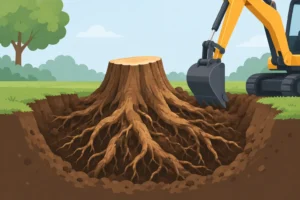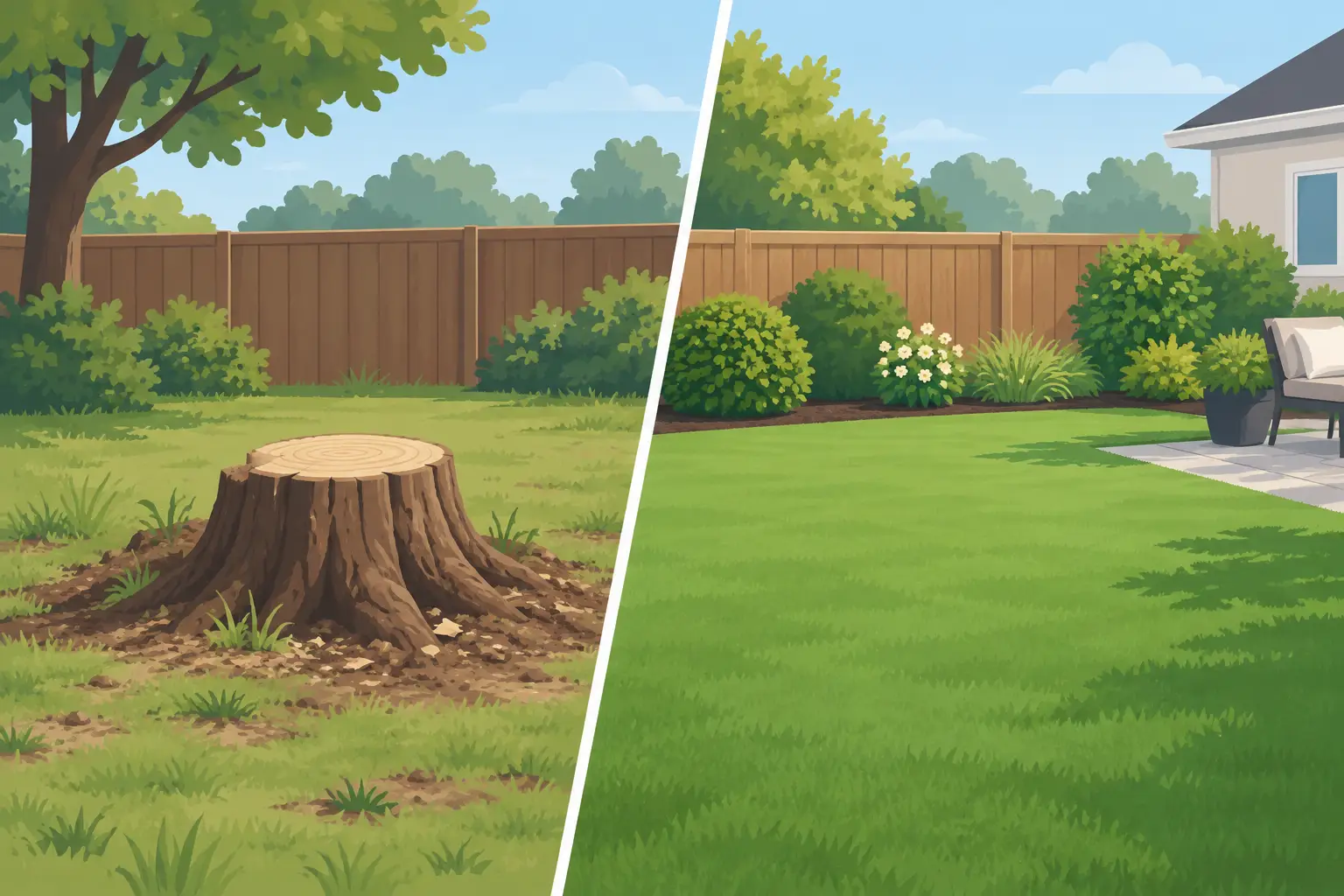
A stump can take up far more room than its diameter suggests. The visible wood is only part of the problem. Roots below grade can keep grass from growing, interfere with a patio or garden bed, and make a small backyard feel difficult to use. This case study of backyard stump space restoration shows how a thorough removal plan can turn an obstacle into usable property again.
For homeowners in New Haven County, the goal is rarely just to make a stump disappear. They want a clean area that is safer to mow, easier to landscape, and ready for the next project. That may mean lawn, a play area, a planting bed, fencing, or room for a shed. The right approach depends on what is below the surface and what the property owner wants to do with the space afterward.
Backyard Stump Space Restoration: The Property Problem
This residential restoration involved a backyard where a mature tree had already been removed. The remaining stump sat near an established lawn and close enough to a planned landscape area that leaving it in place was not a practical option. The homeowner had a familiar set of concerns: the stump made mowing awkward, exposed roots created uneven ground, and the space could not be finished as a usable extension of the yard.
At first glance, this can seem like a straightforward stump-grinding job. In practice, the work required a closer look. The stump location, root spread, nearby lawn, and future use of the area all affected the removal plan. Grinding only the top portion of the stump would improve the appearance, but it would not necessarily solve the root and grading issues that were limiting the yard.
That distinction matters. A stump ground below the surface may be enough when a homeowner simply wants to seed over a small area. If roots are lifting soil, extending into a new garden bed, or occupying space needed for construction, additional root removal may be the better long-term choice.
The On-Site Assessment Comes First
A proper assessment starts with the condition of the remaining stump and the site around it. An arborist-led crew looks at access for equipment, surface roots, drainage, nearby structures, utilities, and the final plan for the area. On a compact Connecticut property, there is often little room for error. A driveway, fence, foundation, septic area, or underground line may be closer than it appears.
The homeowner in this case wanted a level, clean section of backyard that could be reseeded and later landscaped. That changed the scope of the job. Rather than treating the stump as an isolated piece of wood, the crew treated the entire area as a restoration project.
The first decision was how deeply to grind the stump. For lawn restoration, grinding below grade helps prevent the remaining wood from becoming a raised spot as it breaks down. The second decision involved the larger roots. Roots do not always need to be removed across the entire yard. In fact, unnecessary digging can disturb more lawn than needed. The priority is to address roots that interfere with the planned use of the space while protecting surrounding ground and features.
Grinding the Stump Is Only One Part of the Work
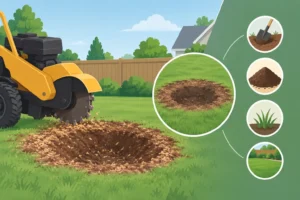
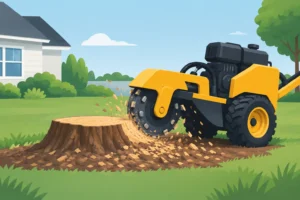
The stump was ground down to create room for proper backfilling and finish grading. This eliminated the hard, visible obstruction and reduced the chance of future settling directly over the stump. Grinding also produced wood chips, which needed to be managed instead of simply left as the final surface.
Wood chips mixed with soil can affect how well new grass establishes. As the organic material decomposes, the ground may settle and a shallow depression can form. For a homeowner who wants a smooth lawn, cleanup and soil preparation are not minor details. They are what separate a partially finished job from a space that is ready to use.
After grinding, attention turned to the remaining roots in the restoration zone. Stumpbuster LLC uses a proprietary Plowrake root removal system designed to pull and clear deeper root material more thoroughly than surface grinding alone. That capability is especially valuable where a homeowner wants to reclaim ground for landscaping, lawn repair, or another improvement that needs a cleaner base.
The goal was not to excavate the entire backyard. It was to remove the root material that prevented the selected area from being leveled and restored. This focused approach limits unnecessary disruption while addressing the part of the root system that was causing the practical problem.
Removing Roots Without Creating a Bigger Mess
Root removal requires judgment. Old roots can extend in several directions, and aggressive digging without a plan can tear up healthy turf, compact soil, or damage nearby landscape features. Equipment should be sized for the property and operated by people who understand where to stop.
In this case, the crew worked the affected area carefully, removing the main root material and loose debris before preparing the ground for finish work. The remaining cavity and disturbed soil were then addressed with clean fill and topsoil as needed. The area was graded to match the surrounding yard rather than left as a low spot that would collect water.
Drainage is an easy issue to overlook when a stump is removed. A level-looking area is not always a properly graded area. If water already moves toward a foundation, walkway, or patio, the restored section must not make that condition worse. On most residential jobs, a slight, controlled slope is enough to keep water moving away from structures while still giving the lawn a natural appearance.
The Difference Was Visible Right Away
Once the stump, targeted roots, chips, and debris were removed, the backyard had a usable footprint again. The homeowner no longer had to mow around a hard obstacle or work around roots beneath the grass. More importantly, the space was prepared for the next step instead of becoming another unfinished corner of the property.
The immediate improvement was visual. The yard looked more open and maintained. The longer-term value came from having options. A clean, graded area can support new seed, sod, a garden bed, a small patio project, or other outdoor improvements without working around decaying wood underground.
This is where a thorough stump service often pays off. A low-cost grind that leaves a large amount of root material and chips may look acceptable for a short time. But if the ground settles, roots remain in the way, or the lawn will not establish evenly, the property owner may need to revisit the area later. The right level of removal depends on the intended use, not just on getting the stump out of sight.
When Stump Grinding Is Enough and When It Is Not
Not every backyard requires full root removal. If a stump is far from structures and the plan is simply to return the area to rough lawn, grinding below grade and adding soil may be the sensible choice. It is generally less disruptive and may cost less than deeper excavation.
More complete removal deserves consideration when roots are lifting a walkway, interfering with a new fence line, preventing grading, or taking up space needed for a patio, shed, pool area, or planting project. It can also be a better option where the homeowner wants to eliminate as much future settling as possible.
A site visit helps determine which approach makes sense. The condition of the wood, the tree species, root depth, yard access, and nearby utilities all influence the scope. An experienced crew should explain those trade-offs clearly before work begins rather than treating every stump as the same job.
A Better Starting Point for the Yard You Want
Backyard space is valuable, especially on established properties where every open section has a purpose. Removing a stump properly creates more than a cleaner view. It gives homeowners a safer, more functional area to maintain and improve.
For property owners in North Haven, Hamden, West Haven, Branford, Guilford, Wallingford, and throughout New Haven County, the best next step is an on-site estimate. A professional can assess the stump, roots, access, and future plans for the area, then recommend the level of removal needed to leave the yard ready for what comes next.