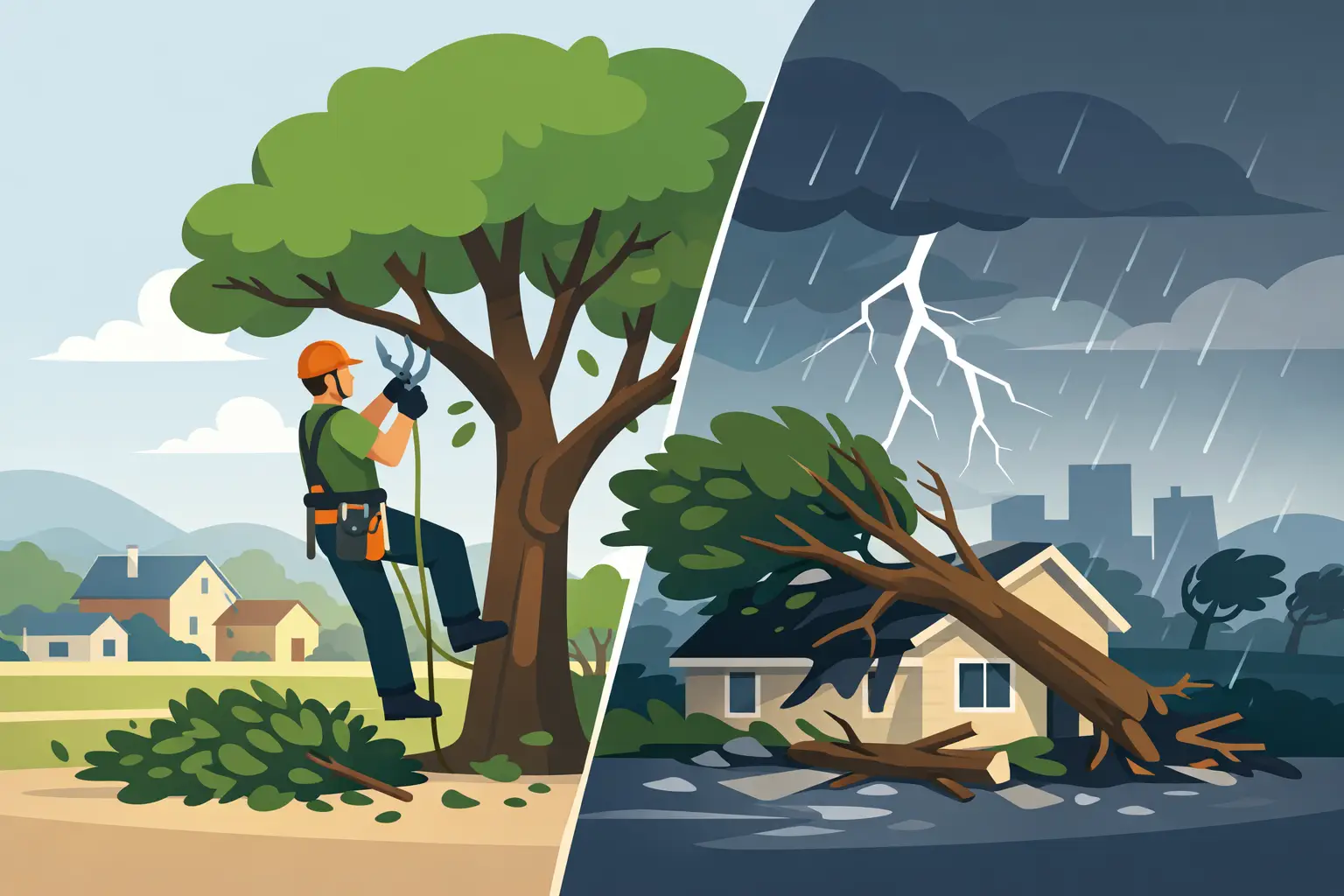
A maple limb over a driveway may look fine on a calm summer afternoon. Add wet snow, saturated ground, or a hard coastal wind, and that same limb can become a real threat to a roof, vehicle, fence, or power line. Will tree trimming reduce storm risk? In many cases, yes – but only when the right branches are pruned for the right reasons.
Good tree trimming is not about cutting a tree back as far as possible. It is careful work that removes failing limbs, corrects poor branch structure, reduces unnecessary wind resistance, and gives a trained arborist a closer look at the tree’s overall condition. For property owners in New Haven County, that can mean fewer surprises when the forecast turns rough.
How Tree Trimming Reduces Storm Risk
Storm damage usually starts at a weak point. That might be a dead branch, a cracked limb, a narrow branch union, or a heavy limb growing too far out from the trunk. Trimming can reduce the chance that these weak points fail under wind, ice, or snow load.
Deadwood removal is one of the clearest safety benefits. Dead limbs no longer have the flexibility or strength of living wood. They can snap without much warning, especially after repeated freeze-thaw cycles or heavy rain. Removing them before storm season keeps them from falling on the areas below.
Selective pruning can also reduce weight at the ends of long, overextended branches. When a branch is too heavy or reaches far beyond the main canopy, wind puts extra leverage on its connection to the trunk. A proper reduction cut can lessen that strain while preserving the natural form of the tree.
A well-maintained canopy allows wind to move through it more evenly. This does not mean stripping the interior of a tree or leaving it bare. It means removing selected branches that are crossing, rubbing, damaged, poorly attached, or creating an overly dense canopy. The goal is a healthier structure, not a smaller-looking tree at any cost.
Will Tree Trimming Reduce Storm Risk for Every Tree?
Tree trimming can lower risk, but it cannot make every tree storm-proof. A healthy, established oak with good structure may only need periodic maintenance. A tree with severe trunk decay, major root damage, a large split, or significant lean toward a house may need more than trimming.
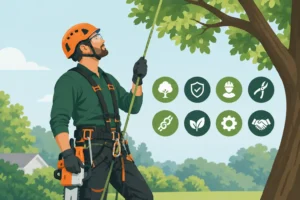
This is where an on-site evaluation matters. A licensed arborist looks beyond the visible branches. They consider the condition of the trunk, major limb attachments, root zone, past pruning cuts, soil conditions, and the tree’s proximity to structures, driveways, and utility lines.
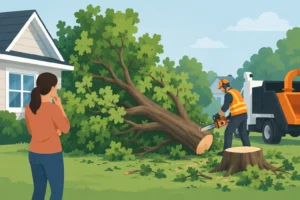
For example, removing a few dead branches from a tree with a hollow trunk may make the canopy safer, but it does not solve the underlying stability problem. Likewise, a tree leaning after a period of heavy rain may be dealing with root failure, not a branch issue. In those situations, removal may be the safer choice.
The right answer depends on the tree, its condition, and what it could hit if it fails. That is why a quick look from the ground is not always enough to judge risk.
Warning Signs That Call for Professional Pruning
Some tree problems deserve attention well before a major storm is in the forecast. Look up regularly, especially after high winds, wet snow, or extended rain. Dead branches, hanging limbs, fresh cracks, and broken tops should be addressed promptly.
Other warning signs are less obvious. Branches that rub against each other can create wounds that invite decay. Multiple trunks joined in a tight V-shaped connection can be more likely to split as they gain weight. Large limbs stretching over a roof, parking area, or play space deserve careful evaluation, even if they still appear healthy.
Pay attention to changes at ground level, too. Mushrooms near the base of a tree, exposed roots, soil lifting on one side, or a lean that seems to be getting worse can point to decay or root problems. Trimming may be part of the solution, but a compromised tree should be inspected before anyone assumes pruning alone will make it safe.
Trees near electrical lines require extra caution. Do not attempt to prune branches near energized wires yourself, and do not assume a branch is safe because it is not touching a line at the moment. Utility clearance and private tree work need to be handled with the proper training, equipment, and coordination.
The Risks of Over-Trimming a Tree
More cutting does not automatically mean more safety. In fact, aggressive trimming can make a tree more vulnerable over time.
Topping, which means cutting major branches back to stubs or cutting the top out of a tree, is a common example. It leaves large wounds, removes much of the tree’s food-producing canopy, and often triggers fast-growing shoots with weak attachments. Those new shoots may become future storm hazards.
Removing too much live growth at once can also stress the tree. A stressed tree has less energy to defend itself from insects, disease, drought, and decay. The best storm-prevention pruning keeps enough healthy canopy for the tree to function while improving its structure and removing problem limbs.
Proper pruning cuts matter just as much as the number of branches removed. Cuts made in the wrong place can damage the tree’s natural ability to close wounds. Cuts made too close to the trunk or too far out can lead to poor healing and decay. This is skilled work, especially on mature trees where the branches are large, high, and close to property.
When to Schedule Storm-Prep Tree Trimming
The best time for pruning depends on the species, the tree’s health, and the reason for the work. Dead, broken, or hazardous limbs should be removed whenever they are found. Waiting for the ideal season is not worth the risk if a damaged branch is hanging over a home or driveway.
For routine structural pruning, many trees can be safely trimmed during dormancy in late fall or winter. With leaves off the branches, the structure is easier to see and crews can identify crossing limbs, weak unions, and deadwood more clearly. Dormant-season pruning can also reduce disruption for certain trees.
Still, there is no reason to wait until winter to have a tree assessed. Connecticut storms can arrive in any season. Spring thunderstorms, summer wind events, tropical systems, and heavy winter snow all expose weak limbs and poor tree structure. Scheduling an inspection before the next major weather event gives you more options than calling after damage has already occurred.
What a Professional Tree Assessment Should Cover
A useful storm-risk assessment should be specific to your property. It should identify which limbs are dead, damaged, overextended, or poorly attached, along with what they could strike if they fail. A professional should also explain whether pruning is enough or whether the condition of the tree calls for removal.
The work plan should account for access, nearby structures, landscaping, fences, and cleanup. Large branch removal is not simply a matter of cutting from the ground. Controlled rigging, safe equipment placement, and an experienced crew help prevent the tree work itself from causing damage.
For commercial properties, assessments should also focus on pedestrian areas, parking lots, entrances, signage, and service access. A single failed limb can create liability, interrupt business, and damage vehicles. Regular maintenance is often easier to budget for than emergency cleanup after a storm.
Make Decisions Before the Wind Picks Up
The most useful tree work is done before a branch lands on the roof. If you have mature trees near your home, driveway, business, or utility service, take a close look now rather than waiting for the next warning on the weather report.
Stumpbuster LLC has served New Haven County properties since 1985 with arborist-led trimming, removal, and thorough cleanup. A professional evaluation can help you decide whether selective pruning will improve safety, whether a tree needs closer monitoring, or whether removal is the responsible next step. A little planning now can protect the property you have worked hard to maintain.