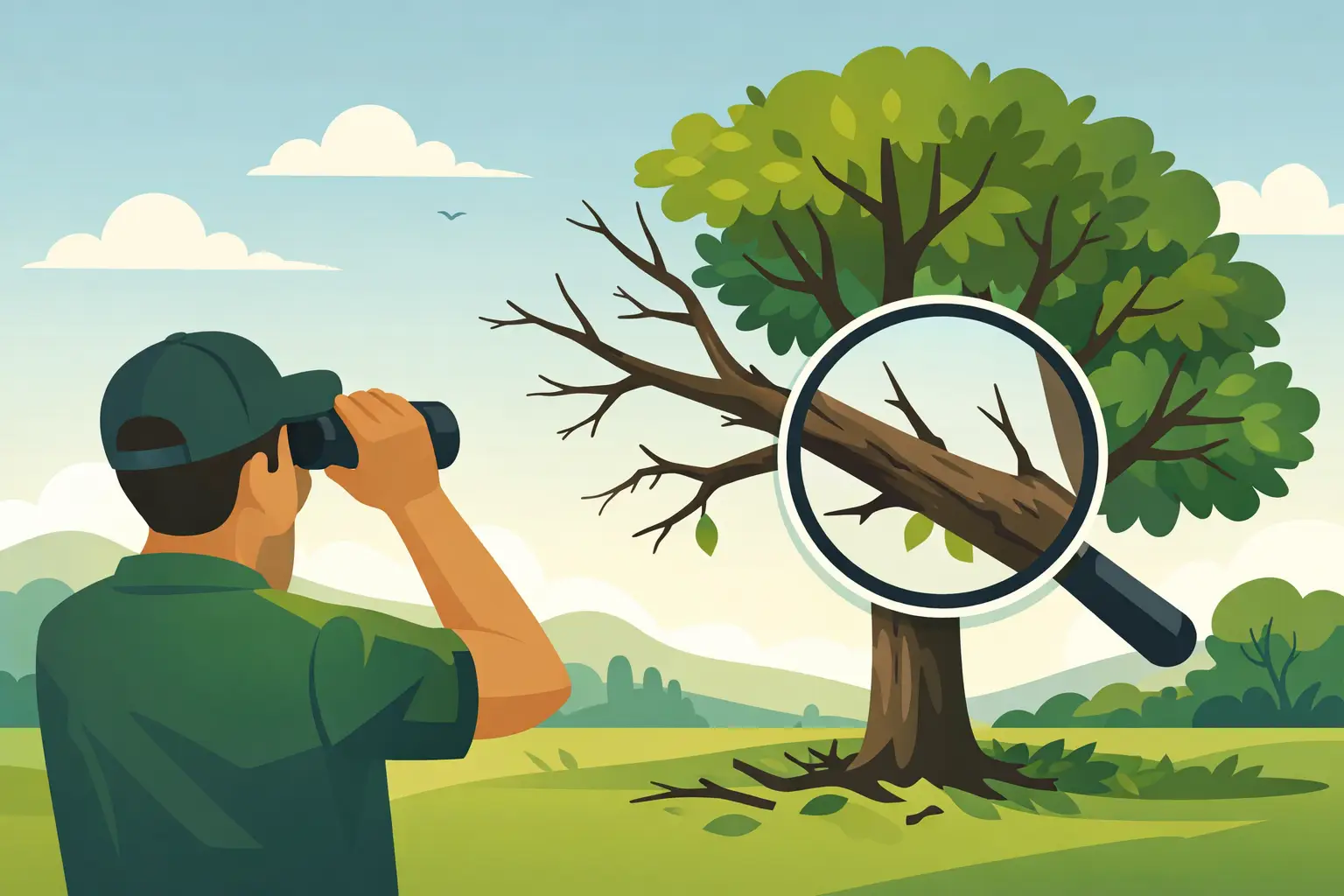
A limb does not have to be hanging over your roof to be a problem. Some of the most dangerous branches look stable from the ground until the first heavy wind, wet snow, or summer storm puts weight on wood that has already died. If you are wondering how to spot dead tree limbs, the good news is there are a few visible signs most property owners can check safely from the ground.
Dead limbs matter for two reasons. First, they fall without much warning. Second, they can be a sign that the tree itself is under stress from disease, root trouble, storm damage, or age. A single dead branch in an otherwise healthy tree is one thing. Multiple dead limbs scattered through the canopy can point to a bigger structural or health issue.
How to spot dead tree limbs from the ground
Start with the simplest question: does the branch still look alive compared to the rest of the tree? On most species, living limbs show some flexibility, fuller bark, and seasonal growth that matches the rest of the canopy. Dead limbs usually stand out once you know what to look for.
One of the clearest signs is missing leaves during the growing season. If most of the tree has leafed out but one branch stays bare, that branch may be dead. In winter, this gets trickier, especially with deciduous trees, so you need to rely more on bark, twigs, and structure.
Brittleness is another clue. A dead branch loses moisture over time and becomes dry and rigid. From the ground, you may notice smaller twigs snapped off cleanly, a branch tip that looks sparse, or sections that appear shriveled rather than flexible. If you can safely reach a fallen twig from that limb, dead wood usually breaks sharply instead of bending.
Look at the bark next. Healthy bark is not always perfect, but it is generally attached and consistent with the species. Dead limbs often have bark peeling away, cracking deeply, or dropping off in patches. When bark is gone, the wood underneath may look dry, pale, or punky.
You should also look for a color change. Dead branches are often duller than living ones. In summer, they can appear gray against a green canopy. In evergreens, dead sections may turn brown or reddish while healthy needles stay green.
Signs a dead limb is becoming hazardous
Not every dead limb needs the same response. A small dead branch high in a backyard maple is different from a large dead leader over a driveway, sidewalk, shed, or play area. The size of the limb and what sits below it matter just as much as the branch condition.
A hazardous dead limb often shows cracking where it joins the trunk or another major branch. That attachment point may look split, sunken, or weak. If the branch has started to sag, rotate, or separate from the tree, that raises the risk level. Fungi growing near the branch union can also suggest internal decay.
Weight and position matter too. Long horizontal limbs tend to put more stress on weak attachment points. If a dead limb extends over a roof, parked vehicles, utility lines, patios, walkways, or neighboring property, it deserves prompt attention even if it has not moved yet.
Storm damage changes the equation. A branch that was partly broken in wind or heavy snow may still be hanging in the canopy. It can stay there for days or weeks, then drop when conditions change. That kind of damaged deadwood is not a watch-and-wait situation.
Dead limb or dormant branch?
This is where many homeowners second-guess themselves. A branch can look lifeless and still be dormant, stressed, or slow to leaf out. That is especially common in early spring, after late frost, or with certain species that break bud later than others.
The easiest way to judge is comparison. If one branch looks different but the rest of the tree is healthy and on schedule, that branch may be dead. If the whole tree is late, thin, or uneven, the issue may be broader than a single limb. Drought stress, compacted soil, root damage, and insect activity can all delay growth.
On younger, reachable plants, people sometimes do a scratch test by lightly scraping the outer bark to look for green tissue underneath. That is not practical or safe for mature shade trees, and it does not tell you much about structural sound. Large tree assessment is better done visually from the ground unless a trained professional is inspecting it.
Common tree-by-tree clues in Connecticut yards
In New Haven County, mature maples, oaks, pines, spruces, and ornamentals each show deadwood a little differently. Maples often reveal dead limbs through bare tips and bark loss in the upper canopy. Oaks may hold dead branches longer, especially in interior sections where light is limited. Pines and spruces often show brown needle clusters or entire dead branch sections that contrast sharply with green growth nearby.
Older ornamental trees can be more subtle. Deadwood may start as isolated twig dieback and then move into larger scaffold branches. If the tree is near a house, driveway, or front walk, even moderate deadwood should not be ignored just because the tree is smaller.
This is also where local experience matters. A branch may be dead because it was shaded out naturally, or because the tree has a deeper health problem. The difference affects whether you need simple pruning or a broader plan for the tree.
What causes tree limbs to die
Sometimes the cause is straightforward. Storm breakage, old pruning wounds, lightning, and heavy snow load can kill a branch outright. In other cases, the branch dies slowly because the tree is under stress.
Root disturbance is a common reason. Construction, trenching, grade changes, and repeated soil compaction can reduce the tree’s ability to support upper limbs. Disease and insect activity can do the same. So can drought, especially when mature trees suddenly lose access to moisture they relied on for years.
Age plays a role as well. Many mature trees naturally develop some interior deadwood over time. That does not always mean the whole tree is failing. The issue is whether the amount of deadwood is normal for the species and whether those limbs create a hazard.
When to call a professional instead of checking it yourself
If the branch is large, high, cracked, over a target, or near wires, do not try to handle it yourself. Tree work goes bad quickly when ladders, chainsaws, and overhead weight get involved. Even a limb that looks detached can still be under tension.
It is also time to call if you see several dead limbs throughout the canopy, mushrooms or decay around major branch unions, a trunk crack, root flare problems, or sudden dieback after a storm. Those are signs the issue may go beyond routine trimming.
A qualified tree professional can tell you whether the limb should be removed, whether the tree needs corrective pruning, or whether removal is the safer call. For property owners in this area, that kind of judgment matters most with older trees near homes, garages, driveways, and commercial buildings.
What not to do with suspected dead tree limbs
Do not climb the tree to get a closer look. Deadwood is unpredictable, and a branch that supports weight one second can fail the next. Do not stand under a damaged limb during windy weather, and do not park vehicles beneath it while you decide what to do.
Avoid the temptation to over-prune if you are unsure. Removing the wrong limbs can stress the tree further or throw off its balance. Good pruning is not just about cutting dead wood. It is about making proper cuts in the right places without creating new problems.
If the branch is close to utility lines, keep your distance and call the proper utility provider or a tree service qualified to work around that hazard. That is not a homeowner job.
A practical way to monitor a tree between inspections
If you are not sure whether a limb has died recently or has looked that way for a while, take a few photos from the same angle every few weeks during the growing season. That gives you a clearer sense of whether the branch is truly inactive, dropping bark, or worsening after storms.
Pay attention after high wind, heavy rain, or wet snow. A branch that seemed stable in fair weather may show new sagging, fresh cracks, or fallen twigs afterward. The sooner you catch those changes, the easier it is to address them before they damage a roof, fence, or yard.
For homeowners and property managers who want a straight answer, this is the kind of issue an experienced local tree company can usually sort out quickly. Stumpbuster LLC has been working with trees across New Haven County since 1985, and when dead limbs are caught early, the fix is often simpler, safer, and less expensive than waiting for a failure.
If a tree on your property is showing bare branches, peeling bark, or storm-damaged wood, trust what you are seeing. Dead limbs rarely improve on their own, and a careful look now can prevent a much bigger problem later.