A branch scraping a roof during a windy Connecticut night is hard to ignore. Other problems are quieter: a dead limb hanging over the driveway, a dense canopy that keeps the lawn damp, or limbs growing toward utility lines. Knowing the top signs a tree needs pruning helps you address a manageable issue before it becomes storm damage, property damage, or a safety concern.
Pruning is not simply about making a tree look neater. Done correctly, it removes hazardous wood, improves structure, reduces unnecessary weight, and gives healthy branches better access to light and air. Done poorly, or at the wrong time, it can leave a tree stressed, weakly shaped, and more vulnerable to pests and decay.
Top Signs a Tree Needs Pruning
Dead, broken, or hanging limbs
Dead branches are the clearest reason to schedule pruning. They may be bare while the rest of the tree is leafing out, have peeling bark, show cracks or fungus, or snap easily when touched. After heavy snow, ice, or wind, inspect the ground and canopy for broken limbs caught in other branches.
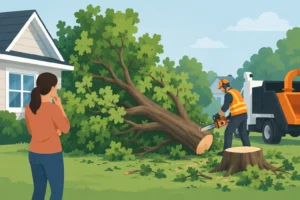
A hanging branch can fall without much warning, especially after another storm or a period of rain. This is a higher priority when it is over a driveway, walkway, play area, roof, fence, vehicle, or neighboring property. Do not try to pull down a large caught branch from the ground. Its weight and direction of fall are difficult to predict.
Limbs touching your home, roof, or chimney
Branches that contact a house can rub shingles, siding, gutters, screens, and trim. They also provide a direct route for squirrels and other animals to reach the roof. Even if the branch looks small now, trees continue to grow, and wind can turn repeated light contact into damage.
Clearance needs depend on the species, location, and the branch’s growth pattern. The goal is not to strip the side of the tree nearest the house. Proper pruning removes or reduces selected limbs while keeping the tree balanced and healthy. Cutting every lower or inward-growing limb at once can create a lopsided canopy and expose the trunk to more sun stress.
Branches growing into power or utility lines
Any branch near an electrical service line deserves caution. Homeowners should never climb, cut, or use pole tools around energized wires. A limb does not have to touch a line to create a dangerous situation, particularly when rain, wind, or a metal ladder is involved.
Call the utility provider if a branch is directly on a power line or if there is an immediate electrical hazard. For trees that are approaching lines but are not in emergency contact, an experienced, insured tree service can assess the situation and explain the safe next step. The same care applies to cable, telephone, and service connections running from the street to a building.
A canopy that is too thick or crowded
Mature trees need a canopy with room for air and sunlight to move through it. When many small branches cross, rub, or grow tightly together, the interior stays shaded and damp. That can encourage leaf disease, make weak branches harder to spot, and increase wind resistance during storms.
Crowding is common in older maples, oaks, ornamental pears, and neglected landscape trees throughout New Haven County. A trained arborist can selectively thin congested growth, remove crossing branches, and retain the limbs that support the tree’s natural structure. Topping a tree or cutting back every branch to a short stub is not a substitute for proper thinning. Those cuts often produce weak new shoots and can shorten the tree’s useful life.
Low branches blocking access or visibility
A healthy branch may still be in the wrong place. Limbs that block a sidewalk, brush against parked cars, interfere with mowing, hide driveway visibility, or strike trucks can make a property harder to use safely. Commercial properties often need clearance over parking areas, entrances, loading areas, and signs. Homeowners may need it over patios, pools, sheds, or frequently used paths.
Raising the canopy can solve these problems, but there is a trade-off. Removing too many lower limbs at once reduces a tree’s ability to support itself and can change its appearance dramatically. The right approach is gradual, selective pruning that maintains enough live crown for the tree’s size and condition.
Signs of disease, decay, or structural weakness
Pruning can help manage certain disease and decay concerns by removing affected limbs before the problem spreads or before a weakened branch fails. Look for unusual dieback at branch tips, large cracks, cavities, mushrooms at the base, loose bark, oozing areas, or branches with very sparse leaves compared with the rest of the tree.
Not every discolored leaf means a tree is failing. Drought, compacted soil, insects, and seasonal conditions can produce similar symptoms. But when poor foliage is paired with dead wood, cracks, fungal growth, or a change in the tree’s lean, it is time for a professional evaluation. Some trees need targeted pruning; others may need cabling, monitoring, or removal if the risk is too high.
New growth after storm damage or past bad cuts
Trees often respond to a hard cut or storm break by sending up fast-growing shoots. These upright sprouts can make a canopy look full again, but they are frequently weakly attached. Left unmanaged, they can become heavy limbs that split away from the old cut years later.
This is especially common on trees that were topped in the past. Corrective pruning can improve the structure over time, but it takes patience. Removing all new growth in one visit may stress the tree further. An arborist should identify which shoots can become stable branches and which should be reduced or removed.
When Is the Best Time to Prune?
For many deciduous trees in Connecticut, late winter is a practical pruning window. Trees are dormant, branch structure is easier to see, and crews can often work without disturbing spring growth. However, timing is not one-size-fits-all. Dead or dangerous limbs should be removed as soon as they are identified, regardless of season.
Flowering trees, evergreens, and trees with active disease concerns may require different timing. Oak pruning, for example, is often scheduled with disease prevention in mind. A professional assessment considers the tree species, its age, the type of cut needed, and whether the issue is safety-related.
What Homeowners Can Handle and When to Call a Pro
Small twigs that can be cut safely from the ground with hand pruners are usually manageable for a homeowner. Keep cuts clean, avoid cutting into the branch collar where a limb joins the trunk or another branch, and do not remove a large portion of live canopy in a single season.
Once a job requires a ladder, chainsaw, climbing, rigging, work near wires, or removal of limbs over a structure, it is no longer a casual yard task. Large branches can twist, spring back, or strike an unseen target as they fall. The cost of professional pruning is often far less than the cost of a damaged roof, injury, or emergency cleanup.
Stumpbuster LLC has served New Haven County properties since 1985 with licensed arborist oversight, insured tree work, and thorough cleanup. Whether a tree needs routine structural pruning or urgent removal of hazardous limbs, a site visit can clarify the safest option without guessing from the ground.
If you see dead wood, roof contact, crowding, or a branch that does not look secure, take a photo from a safe distance and request an estimate before the next strong wind tests it.