A branch hanging over a roof, driveway, walkway, or service line can go from a minor concern to a property emergency in one storm. This guide to safe branch clearance helps New Haven County property owners recognize the risks, handle small jobs responsibly, and know when the work calls for trained tree professionals.
Start With the Clearance Problem, Not the Saw
Safe branch clearance is not simply cutting back every limb that seems too close. The first step is identifying what the branch could hit, what may fall beneath it, and what condition the tree is in. A healthy limb growing near a roof may need measured pruning. A cracked, dead, or heavily leaning limb may require a more controlled removal plan.
Walk the area from the ground and look for branches over roofs, decks, garages, fences, sidewalks, parking areas, play spaces, and driveways. Also check where limbs approach utility lines, service drops, exterior lights, gutters, chimneys, and solar panels. The branch you can see is only part of the picture. Its weight, angle, hidden decay, and connection to the trunk all affect how it will move when cut.
Clearance needs also depend on the location. A limb over a rarely used corner of the yard does not carry the same urgency as one over the front walk, where guests and delivery drivers pass every day. Commercial properties should pay particular attention to entrances, parking lots, sidewalks, loading areas, and any place employees or customers gather.
Know When Branch Work Is a Professional Job
Some light pruning can be reasonable for a homeowner, but tree work becomes dangerous quickly. The safest decision is often to leave a branch in place until the right equipment and experienced crew are available.
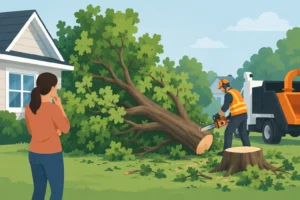
Call a qualified, insured tree service when a branch is dead, split, suspended, or too heavy to control from the ground. The same applies when work requires climbing, using a ladder with a saw, working above a structure, or cutting near traffic. A falling limb does not always drop straight down. It can swing, roll, bounce, strike another branch, or pull loose unexpectedly as weight shifts.
Never attempt to trim a branch that touches or is close enough to reach a power line. Keep yourself, ladders, tools, and cut branches well away from electrical lines. Contact the utility company if a line is down, damaged, or obstructed, and use a tree professional with the proper training for clearance work near service lines.
There are warning signs that make a tree assessment especially worthwhile: peeling bark, fungus at the base, cavities, long vertical cracks, soil lifting around the roots, branches dying back at the top, or a recent change in lean. Pruning a compromised tree without understanding its stability can create a more serious hazard.
Plan the Drop Zone Before Making Any Cut
For small, reachable branches that are clearly safe to prune, take time to set up the work area. Keep people, pets, vehicles, and outdoor furniture out of the drop zone. Move lawn equipment and anything breakable. Do not assume a branch will fall where you expect, especially if it is curved, tangled with another limb, or under tension.
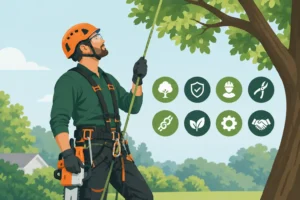
Wear eye protection, sturdy gloves, long pants, work boots with good traction, and hearing protection when using powered equipment. A hard hat is a smart precaution whenever branches are overhead. Avoid loose clothing, and do not work alone. A second person can keep the area clear and call for help if something goes wrong, but they should never stand beneath the branch or try to catch it.
Weather matters. Do not work in wind, rain, snow, ice, or poor visibility. In Connecticut, wet leaves, frozen ground, and gusty conditions can make even a routine yard task unpredictable. Wait for calm, dry conditions, and postpone the job if the tree or ground does not feel stable.
Ladders deserve special caution. A ladder placed against a tree is not a secure work platform, and operating a chainsaw from a ladder is a high-risk situation. If the branch cannot be cut safely with both feet on the ground, it is time to call a professional.
Use Proper Pruning Cuts to Protect the Tree
Clearance pruning should remove a problem without causing unnecessary damage to the tree. Poor cuts can invite decay, weaken the branch structure, and lead to more future maintenance.
When removing a branch at its point of attachment, look for the branch collar – the slightly swollen area where the branch joins the trunk or larger limb. Cut just outside that collar. Do not cut flush against the trunk, and do not leave a long stub. Both mistakes slow the tree’s natural ability to close the wound.
For a small branch, a clean hand-pruner or pruning saw may be enough. For a larger limb, use the three-cut method to prevent the bark from tearing down the trunk. Make a shallow undercut several inches out from the branch collar. Make a second cut from the top, farther out than the undercut, so the branch breaks away safely. Then remove the remaining stub with a final cut just outside the collar.
Do not top a tree by cutting major upright leaders back to stubs. Topping creates large wounds and often triggers weak, fast-growing shoots that become another clearance problem later. If a tree has outgrown its space or is repeatedly interfering with a roof or utility area, selective reduction by an arborist is usually a better option. In some cases, removal and replacement with a more suitable tree is the responsible long-term choice.
How Much Clearance Does a Home Need?
The right distance depends on the tree species, branch movement, roof design, and the feature being protected. Branches grow, flex in the wind, and hold snow and ice. A limb that appears clear in summer can scrape a roof during a winter storm.
As a practical rule, roof-adjacent branches should not rest on shingles, gutters, flashing, or siding. Keeping a clear gap helps reduce abrasion, moisture buildup, leaf accumulation, and animal access to the roofline. It also makes roof and gutter maintenance easier. However, avoid stripping the entire side of a tree just to create an oversized gap. Removing too much live canopy at once can stress the tree.
For driveways and walkways, clearance should allow vehicles and pedestrians to pass without brushing branches. The needed height varies between a private path, a family SUV, a delivery route, and a commercial parking area. Consider the tallest regular vehicle that uses the space, not just the car parked there today.
Clear branches away from windows and exterior fixtures, but preserve enough canopy to maintain the tree’s balance and appearance. A licensed arborist can determine whether individual limbs should be shortened, removed, or supported with a more complete pruning plan.
Avoid Common Clearance Mistakes
The biggest mistake is waiting until a branch is already scraping the house or hanging over a target. Regular inspections catch developing conflicts while cuts are smaller, safer, and less stressful for the tree. Check mature trees after major storms and at least once each year, particularly around structures and high-use areas.
Another common error is removing too much green growth in one visit. Mature trees need their leaves to produce energy. Heavy thinning can expose bark to sun damage, encourage weak regrowth, and reduce the tree’s natural stability. It may be better to phase needed work over time, depending on the species and condition of the tree.
Homeowners should also resist the temptation to use a chainsaw for work beyond their experience. A chainsaw is not a shortcut around a difficult branch. Kickback, unstable footing, hidden tension in wood, and an uncontrolled drop can turn a small clearance job into a serious injury or costly repair.
Get a Clear Plan for Mature or Hazardous Trees
Large trees near homes, utility lines, or neighboring property need more than a quick visual judgment. The work may require climbing systems, aerial equipment, rigging, traffic control, or careful piece-by-piece removal to protect the property below. That level of planning is what separates professional tree care from simple yard cutting.
For homeowners and businesses throughout New Haven County, Stumpbuster LLC provides arborist-led tree trimming and removal with an emphasis on safe work, careful property protection, and thorough cleanup. An on-site evaluation can identify whether a branch needs routine pruning, hazard reduction, or a larger tree care solution.
If a branch has become a concern, do not wait for the next heavy wind or wet snowfall to test it. A timely inspection gives you a safer yard, clearer access around your property, and a better chance to address the problem before it becomes an emergency.