A branch does not have to fall through shingles to cause trouble. Limbs that scrape a roof in the wind can wear away granules, damage flashing, clog gutters, and give squirrels or insects a direct route toward the house. To prevent roof branch damage, homeowners need to look beyond the obvious overhanging limb and address the tree’s health, structure, and distance from the building.
In New Haven County, mature maples, oaks, pines, and ornamental trees face heavy snow, ice, strong coastal storms, and summer thunderstorms. A branch that looks harmless in calm weather may become a major risk when it is carrying wet leaves, snow, or ice. Timely trimming is usually less costly and less disruptive than emergency storm cleanup or roof repair.
Start With the Branches Closest to the Roof
The first priority is any limb that touches the roof, gutter, chimney, siding, or utility service line. Branches should not rub against roofing materials. Repeated contact can loosen shingles and flashing, especially when wind moves the limb back and forth for months at a time.
A practical clearance target depends on the tree species, its growth rate, and the roof layout. Fast-growing trees may need more room than slow-growing mature trees. The goal is not to strip the tree away from the house. It is to create enough separation that normal wind movement and seasonal growth will not bring limbs back into contact with the structure.
Look up from several points around the yard. A branch that appears clear from ground level may extend over the roof when viewed from another angle. Also check for limbs hanging above valleys, skylights, gutters, lower roof sections, and areas where rooflines meet. These locations collect leaves and water, so even small amounts of branch debris can create an ongoing maintenance issue.
Know Which Warning Signs Need Prompt Attention
Some trees need routine pruning. Others need a closer assessment before the next storm arrives. Dead branches are an obvious concern, but decay and poor branch structure can be just as serious.
Watch for deadwood with no buds or leaves, cracks where a limb joins the trunk, hanging or partially broken branches, mushrooms growing at the base, peeling bark, and cavities in major limbs. A branch with a narrow V-shaped attachment can be weaker than one with a broad, well-formed connection. Multiple stems growing from the same point may also split under snow or wind load.
Evergreen branches deserve attention too. Pine limbs can hold snow and ice for long periods, adding substantial weight. If a pine is leaning toward the house or has dead lower limbs over the roof, do not assume it is safe simply because the tree is green.
A visual check from the ground is useful, but it has limits. Decay can be hidden inside a limb, and roof-adjacent work often requires climbing, rigging, or aerial equipment. If a large limb is over a home, garage, deck, or driveway, an arborist-led inspection is the safer way to determine whether selective pruning, cabling, or removal is appropriate.
Prevent Roof Branch Damage With Proper Pruning
Proper pruning removes the right branches without creating new problems for the tree. Cutting too much at once can stress a tree, encourage weak regrowth, or expose bark to sun damage. Topping a tree by cutting major limbs back to stubs is especially damaging. It often produces fast-growing shoots with weak attachments, creating a larger hazard later.
Instead, pruning should focus on dead, damaged, crossing, and overextended limbs. A skilled crew can reduce the length of a branch by cutting back to a suitable lateral limb, improving clearance while preserving the tree’s natural form. This is often the best approach for healthy mature trees near a roof.
Timing depends on the species and the condition of the tree. Dead or broken limbs can be removed whenever they pose a hazard. For planned pruning, dormant-season work is often a good option for many deciduous trees because leaves are off and branch structure is easier to see. However, there is no one calendar rule for every tree. Oaks, flowering trees, and stressed trees may need a different approach.
Avoid the temptation to use a ladder and chainsaw near the roof. Uneven ground, wet leaves, power lines, and the unpredictable movement of a cut limb make this one of the more dangerous jobs on a property. A damaged gutter is frustrating. A fall or a limb through a window is far worse.
Keep Gutters and Roof Valleys Clear
Overhanging branches create more than impact risk. Leaves, needles, twigs, and seed pods collect in gutters and roof valleys, holding moisture where it does not belong. When gutters back up, water can overflow behind fascia boards or spill near the foundation.
Trimming back the branches that constantly feed debris into the roof drainage system can reduce cleanup needs. It will not eliminate seasonal leaf fall, particularly in wooded neighborhoods, but it can make gutter maintenance more manageable. Branches that shed heavily directly over a valley or flat roof section deserve special attention.
Do not rely on gutter guards as the only answer. They can help in some situations, but needles and small debris may still collect on top of them or wash into roof valleys. Tree clearance and regular roof maintenance work together.
Prepare Before Connecticut Storm Seasons
Most roof branch damage happens when a weather event exposes a problem that was already developing. Late summer thunderstorms can break heavy leaf-covered limbs. Winter storms add ice and snow weight. Nor’easters can twist branches in directions they rarely move during ordinary wind.
A seasonal walk-around helps catch changes early. Before winter, check for limbs over the roof, driveway, vehicles, and service lines. In spring, look for winter breakage and branches that are starting to rub the house. After any significant storm, inspect the yard from a safe distance for newly cracked limbs, hanging branches, or fresh debris on the roof.
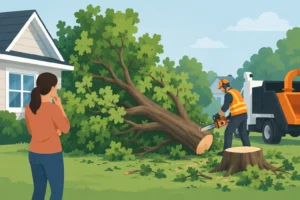
If a branch is resting on the roof after a storm, do not pull it down from a window, ladder, or rooftop. It may be under tension, hooked into another limb, or supported by damaged roofing material. Keep people away from the area and arrange professional removal, particularly if wires are nearby.
Consider the Whole Tree, Not Just One Limb
Sometimes a single overhanging branch can be pruned and the issue is resolved. Other times, the branch is a symptom of a larger problem. A tree with extensive decay, a severe lean, root damage, or repeated limb failure may not be a good long-term fit near a structure.
Removal is not always necessary, and healthy mature trees provide shade, value, and character. Still, when a tree has a high likelihood of failing onto a home, taking it down in a controlled manner is safer than waiting for a storm to decide the outcome. The decision should account for tree condition, target areas below it, available clearance, and whether nearby trees can be protected during the work.
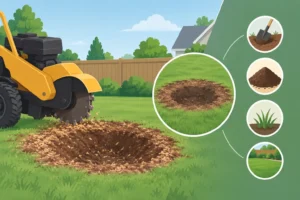
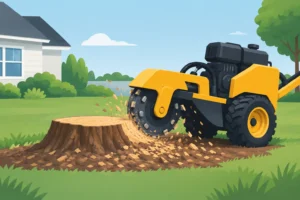
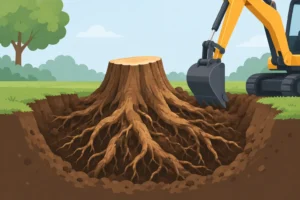
Stump removal can also matter after a problem tree comes down. A remaining stump may create a mowing obstacle, attract pests, or leave roots that interfere with future landscaping. For properties where a clean reset is needed, deeper stump and root removal can restore usable space for lawn, planting, or a replacement tree set safely away from the house.
When to Call a Professional Tree Crew
Routine pruning may be straightforward when small branches are reachable from the ground. Call for professional help when limbs are large, overhang a roof, are close to utility lines, show signs of decay, or require climbing and rigging. Insured tree professionals have the equipment and experience to control where material lands and avoid damage to roofs, landscaping, and surrounding structures.
For homeowners and property managers in New Haven County, Stumpbuster LLC brings licensed arborist oversight and decades of local tree-care experience to pruning, removal, and cleanup work. An on-site assessment can identify the practical work needed now and help prevent a small clearance issue from becoming an emergency.
A few well-chosen cuts, made before the next heavy wind or snow event, can protect the roof while keeping the tree healthy and the yard looking like it should.