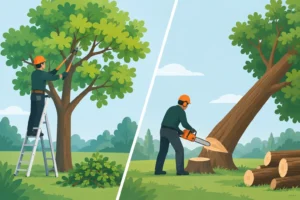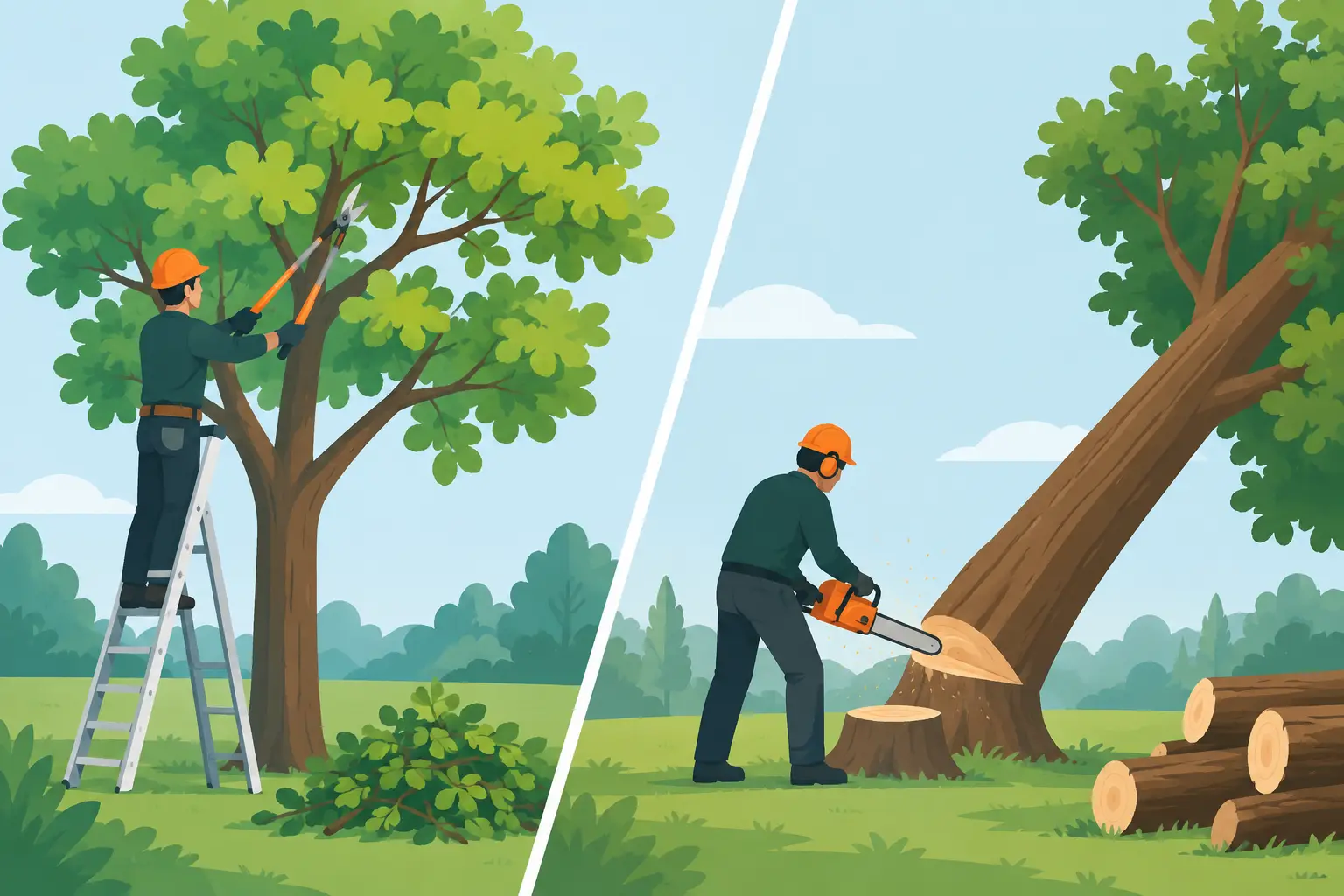
A mature oak leaning toward a garage, a maple with dead limbs over the driveway, and an ornamental tree crowding a roofline may all look like “tree work.” But tree cutting versus tree pruning involves very different decisions. One may remove a hazard or clear space for a project. The other is meant to preserve a tree while correcting a specific problem. Choosing the wrong approach can leave a property less safe, a tree stressed, or both.
For homeowners and commercial property managers in New Haven County, the right service depends on the tree’s condition, location, species, and long-term value. A trained arborist looks beyond the branch that is bothering you and considers the whole tree, the surrounding structures, and the work needed to leave the property clean and usable.
What Tree Cutting Usually Means
Tree cutting is a broad term, but it generally refers to removing a tree or taking off major sections of one. It may include cutting down a dead, declining, storm-damaged, overcrowded, or poorly located tree. It can also mean removing large limbs when a tree has become unsafe or is interfering with a building, driveway, utility area, fence, or planned construction.
The purpose is usually clearance or risk reduction. A tree that has lost structural integrity from decay, root damage, insect activity, or storm failure may not be a good candidate for preservation. Cutting and removing it before it fails can protect people, vehicles, roofs, and neighboring property.
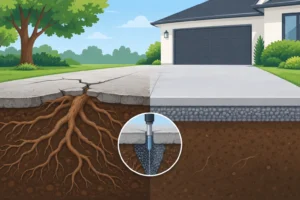
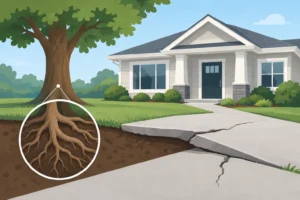
Tree removal is not always about an obviously dead tree. A healthy tree can still be the wrong tree for its location. Roots may be lifting pavement, the canopy may be repeatedly scraping the house, or the trunk may be too close to a foundation. In these cases, repeated heavy cutting is often not a real solution. Removal may be the more responsible choice.
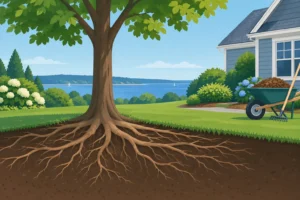
Cutting a tree down is only one part of the job. The remaining stump and roots can continue to take up valuable yard space, interfere with mowing, attract pests, or complicate landscaping. Stump grinding and deeper root removal are worth discussing when the goal is a clean area for grass, a patio, a garden, or future planting.
What Tree Pruning Is Designed to Do
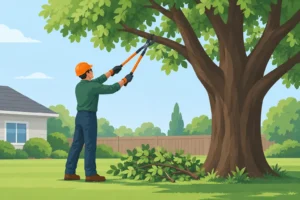
Tree pruning removes selected branches while keeping the tree intact. Proper pruning is controlled, purposeful work. It may remove deadwood, reduce the weight of an overextended limb, improve clearance above a walkway, keep branches away from a roof, or improve airflow through an overly dense canopy.
Good pruning should make a tree safer and healthier without changing its natural form beyond recognition. For example, removing a dead limb above a play area is a safety measure. Reducing a limb that reaches over a roof can prevent damage and limit the buildup of leaves and twigs in gutters. Selectively thinning crowded branches can help reduce rubbing and allow more light into the lawn or landscape below.
Pruning is also valuable for young trees. Early structural pruning can guide a developing tree toward a stronger branch arrangement and reduce the chance of major corrections later. It is often easier, safer, and less expensive to address poor branch structure when a tree is small than after it has grown over a home or parking area.
There is a limit, however. Pruning cannot correct every problem. A tree with extensive trunk decay, a failing root system, or major storm damage may need removal instead. Cutting back the visible symptoms while ignoring the tree’s overall stability can create a false sense of security.
Tree Cutting Versus Tree Pruning: The Main Difference
The simplest distinction is the objective. Tree cutting removes the tree, or a substantial part of it, because it is unsafe, unwanted, or incompatible with the site. Tree pruning keeps the tree and selectively removes branches to improve safety, health, clearance, or appearance.
The difference matters because trees do not recover from every cut the same way. Removing the wrong large branch can weaken the tree, expose it to decay, or encourage weak new growth. Topping, which means cutting off the upper portion of a tree indiscriminately, is especially damaging. It leaves large wounds, ruins the tree’s shape, and often produces fast-growing shoots that are more weakly attached than the original branches.
A proper recommendation should answer a practical question: can this tree be managed safely and reasonably, or has it reached the point where removal is the better property decision? There is no one-size-fits-all answer. A valuable shade tree with a few dead limbs may need pruning. The same species with a split trunk over a house may need careful removal.
Signs Your Tree May Need Pruning
Pruning is often the right service when the tree is generally sound but has branches creating a specific issue. Dead, cracked, hanging, or rubbing limbs should be inspected, particularly when they are over a driveway, entryway, patio, or parking area. Branches growing into the roofline or against siding also deserve attention before they cause avoidable damage.
Dense growth can be another reason to prune. When branches are crossing, competing, or shading the interior of the tree too heavily, selective thinning may improve the canopy. Low branches that block a sidewalk, vehicle access, or sightlines near a driveway can often be raised without compromising the tree.
Timing depends on the species and the reason for the work. Dead or dangerous branches should not wait simply because of the season. For routine maintenance, an arborist can recommend a schedule that takes tree health, local weather, and growth patterns into account.
Signs Removal May Be the Safer Choice
Removal becomes more likely when the tree has a serious structural or health issue that pruning cannot solve. Large cavities, extensive decay at the base, a trunk crack, a heavy lean that has recently changed, or roots lifting out of the ground are warning signs. Mushrooms growing near the base can also point to decay, although they need professional evaluation rather than assumptions.
Storm damage deserves prompt attention. A limb that is partly attached, a split leader, or a tree resting on another tree can shift without warning. Do not climb the tree, pull on damaged branches, or work beneath a suspended limb. Keep people and vehicles out of the area and have a qualified tree service assess the situation.
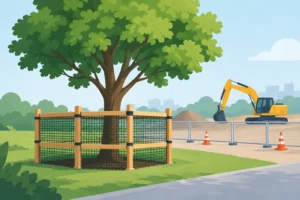
Location can turn an average tree problem into an urgent one. Trees close to homes, garages, power lines, busy driveways, and neighboring structures require careful planning, proper equipment, and controlled removal methods. If utility lines are involved, homeowners should contact the utility provider or a qualified professional rather than attempt any cutting themselves.
Why Experience Matters on Connecticut Properties
New Haven County properties often have mature hardwoods, tight residential lots, stone walls, established gardens, and structures close to the work area. That makes tree work more than a matter of using a chainsaw. The crew needs to understand how to lower material safely, protect the lawn where possible, manage access, and leave the site in good condition.
An arborist-led assessment can identify issues that are easy to miss from the ground, such as included bark between major stems, decay around an old pruning wound, or a branch that is carrying too much weight at the end. It also helps avoid unnecessary removal. A tree that looks overgrown may only need targeted pruning. On the other hand, a tree that still has green leaves can be structurally unsound.
Insurance, equipment, and cleanup should be part of the conversation before work begins. Ask what will be removed, whether brush and wood will be hauled away, how the work zone will be protected, and whether stump grinding or root removal is needed after a tree comes down. Clear expectations prevent surprises once the crew arrives.
Make the Decision Before the Next Storm
Waiting until a branch lands on the roof usually turns a manageable job into an emergency. Walk your property after high winds and look for fresh cracks, hanging limbs, changes in lean, exposed roots, or branches touching the house. If something does not look right, it is better to have it evaluated early.
For routine care, think about how the tree will fit your property five or ten years from now. A well-pruned tree can provide shade, curb appeal, and value for decades. A declining or poorly placed tree can become an ongoing liability. Stumpbuster LLC has served New Haven County since 1985, providing arborist-guided tree work, clean removal, and thorough stump and root solutions when clearing space is the right call.
The best next step is not automatically to cut or to prune. It is to make a sound decision based on the tree in front of you, the people and structures around it, and the result you want from your property.