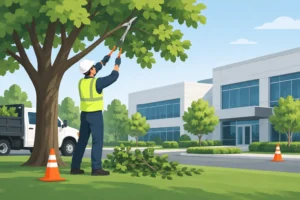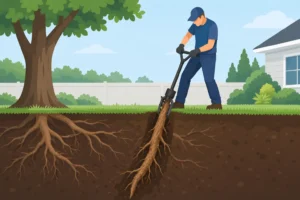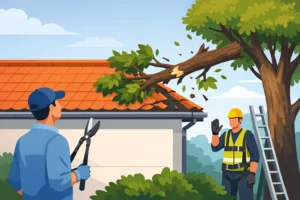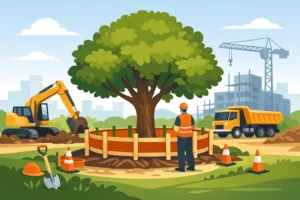
A tree hanging over a roof, a dead limb above a driveway, or roots lifting a walkway is not the time to hire the first company that answers the phone. Tree work involves heavy equipment, overhead hazards, nearby structures, and often utility lines. Knowing how to choose a tree contractor helps protect your property, your budget, and the people using the space.
The right contractor does more than cut branches or remove a trunk. They assess the condition of the tree, plan the safest way to complete the work, protect the surrounding landscape, and leave the property clean when the job is done. For homeowners and commercial property managers in New Haven County, a little screening before work begins can prevent expensive problems later.
How to Choose a Tree Contractor for Your Property
Start by looking for experience that matches the job in front of you. A company that handles routine pruning may not be the right fit for a large tree removal over a house, a difficult stump near a foundation, or roots spread beneath a lawn and driveway. Ask how often the contractor performs work similar to yours and what equipment they use to do it safely.
Local experience matters, too. Connecticut properties often have mature maples, oaks, pines, and ornamental trees growing close to homes, stone walls, fences, septic areas, and overhead service lines. A contractor who has worked in your area understands the access challenges and seasonal conditions that affect a job. They should be able to explain how they will get equipment into the yard and how they will avoid unnecessary damage to turf, gardens, pavement, and structures.
A contractor should also inspect the site before giving a firm price. Be cautious when someone offers a removal quote based only on a photo or a quick description, especially for a large or hazardous tree. Photos can be useful for an initial conversation, but they do not show hidden decay, lean, drop zones, ground conditions, utility concerns, or the space needed for trucks and machinery.
Ask about arborist knowledge, not just cutting equipment
A qualified tree professional knows that every tree does not need to come down. Sometimes selective pruning, deadwood removal, cabling, or monitoring is the better answer. Other times, a declining or structurally compromised tree creates a risk that pruning cannot solve.
Ask who evaluates the tree and whether the company has licensed arborist oversight or comparable professional tree-care qualifications. The person quoting the work should be able to explain, in plain language, why removal, trimming, or stump work is recommended. If the answer is simply, “It looks bad,” ask for more detail.
This is particularly important when a tree appears healthy but has large dead limbs, a split trunk, mushrooms at the base, storm damage, or roots affected by construction. The visible problem may be only part of the issue. A knowledgeable assessment helps you avoid paying for unnecessary work while still addressing real safety concerns.
Verify Insurance Before Anyone Starts Work
Tree work is high-risk work. A contractor can be experienced and still face unpredictable conditions, from a hidden hollow trunk to a sudden change in wind. Proper insurance is not a formality. It is one of the clearest signs that a company takes responsibility for its work.
Ask for proof of current general liability insurance and workers’ compensation coverage. Do not hesitate to review the documentation or ask questions about it. If a company uses a crew, workers’ compensation coverage is especially important. Without it, a property owner could be exposed to serious liability if someone is injured on site.
Also ask whether the company performs the work with its own trained crew or regularly subcontracts it. Subcontractors are not automatically a problem, but you should know who will be on your property, who carries the insurance, and who is accountable for the finished work.
A low estimate from an uninsured operator may look appealing until a branch damages a roof, a truck tears up a lawn, or a worker is hurt. The savings disappear quickly when the risk shifts back to the property owner.
Compare Written Estimates by Scope, Not Just Price
Two removal estimates can be hundreds or thousands of dollars apart because the companies may not be pricing the same job. One may include careful sectional removal, hauling, stump grinding, and final cleanup. Another may only cut the tree down and leave the trunk, brush, and stump behind.
A clear written estimate should identify the trees or limbs involved and explain what will happen to the debris. It should also state whether stump grinding is included, how deep the grinding will go, whether surface roots will be addressed, and whether wood will be removed or left for the customer.
For a meaningful comparison, make sure each estimate answers these points:
- Is all brush, wood, and debris included in removal and disposal?
- Is stump grinding included, and is root removal needed for the intended use of the area?
- Will the crew protect nearby lawn areas, landscaping, fences, and hardscape?
- Who handles permits, traffic control, or utility coordination if they are required?
- What cleanup will be completed before the crew leaves?
Do not assume “cleanup included” means the same thing to every contractor. Ask whether it includes raking smaller debris, blowing sawdust from paved areas, and removing wood chips. If you plan to plant grass, install a patio, replace a fence, or create a garden where the stump stood, discuss that goal before the work is quoted. Standard stump grinding may be enough in one yard, while deeper root removal is necessary in another.
Look for a Safety Plan That Fits the Site
Professional tree work should never look improvised. Before the saw starts, the crew should have a plan for the tree’s condition, the direction of the fall or lowering zone, nearby buildings, access routes, and where equipment will be staged.
Ask how the company handles trees near power lines. A contractor should recognize when utility involvement is necessary and should not make promises that put people or electrical service at risk. The same applies to trees over roofs, garages, pools, septic systems, and busy driveways. These jobs often require controlled dismantling with ropes, rigging, lifts, or cranes rather than a simple felling cut.
Equipment is another clue. The best equipment depends on the site, not on what looks biggest or fastest. A compact machine may be the right choice for a narrow backyard. A crane or bucket truck may be appropriate for a large, hazardous tree with limited drop space. A reputable contractor explains the approach and the trade-off between speed, cost, access, and property protection.
Check Reputation, Communication, and Cleanup Standards
A long local track record is worth more than a polished advertisement. Ask neighbors, check recent customer feedback, and pay attention to how the company communicates before you hire them. Are calls returned? Are questions answered directly? Does the estimate match what was discussed? Small details during the estimate process often predict how the work will be managed.
You can also ask for examples of similar local jobs. A dependable contractor should be comfortable discussing the kind of work they perform, the challenges involved, and the results customers can expect. For commercial clients, it is reasonable to ask about scheduling around tenants, customers, parking areas, or normal business operations.
Cleanup should be part of the contractor’s standard, not an afterthought. Tree removal can leave chips, sawdust, small branches, ruts, and compacted areas if the crew is careless. Some minor impact is unavoidable on difficult jobs, particularly after rain or where access is tight. What matters is whether the company sets realistic expectations and takes practical steps to minimize the impact.
Be Careful With Pressure and Unrealistic Promises
Be wary of a contractor who pressures you to decide immediately, insists on cash only, refuses to provide paperwork, or cannot explain the work in a way you understand. The same caution applies to a quote that is dramatically lower than all others without a clear reason.
Emergency tree work is different. After a storm, fast action may be necessary to remove a limb from a roof, clear a blocked drive, or address an immediate hazard. Even then, ask for the scope of emergency work and what remains to be done afterward. A temporary safety cut may not include full removal, stump grinding, or final cleanup.
Choosing a local company with arborist knowledge, proper insurance, capable equipment, and a written plan gives you a much better chance of a safe, clean result. Stumpbuster LLC has served New Haven County properties since 1985 with that practical approach: assess the site, do the work carefully, and leave the property ready for what comes next.
Before you approve any tree job, take the time to ask the questions that matter. A contractor who welcomes them is usually one who is prepared to earn your trust.