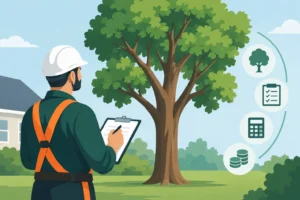
When a contractor is standing in your yard looking up at a leaning oak or a dead limb over the driveway, that is the moment to ask the right questions. The best questions for tree service estimates can tell you very quickly whether you are talking to an experienced professional or someone with a chainsaw and a pickup truck. In tree work, that difference matters.
A low number on paper does not always mean you are getting the better deal. It may mean the estimate leaves out cleanup, stump grinding, traffic protection, utility coordination, or the kind of careful rigging needed near a house, fence, or landscaped area. A good estimate should give you confidence, not just a price.
Why the estimate conversation matters
Tree work is not a simple haul-away job. It affects safety, property value, access, drainage, curb appeal, and sometimes the long-term health of nearby trees. If a tree is close to a roofline, over a patio, tangled in utility corridors, or growing through hardscape, the method matters just as much as the final result.
That is why estimates should be more than a quick glance and a round number. A qualified company should be able to explain what they see, what they recommend, what could complicate the job, and what the final site condition will look like when they leave.
Best questions for tree service estimates before you hire
The first question is simple: What exactly is included in this estimate? Ask for a clear explanation of the scope of work. Are they removing the whole tree or only taking down hazardous sections? Are they hauling away all debris? Is stump grinding included, or is that a separate charge? If roots are part of the problem, ask whether root removal is included or if the stump will be left below grade.
This question matters because many disputes start with assumptions. One homeowner thinks cleanup means the yard will be rake-clean. The contractor means only the larger wood will be loaded out. It is better to define that before work starts.
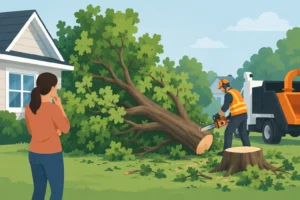
Next, ask how they plan to perform the job on your property. A professional should be able to describe whether the tree will be climbed, rigged down in sections, lifted by crane if necessary, or felled in a controlled direction if there is enough space. This tells you a lot about how seriously they take safety and property protection.
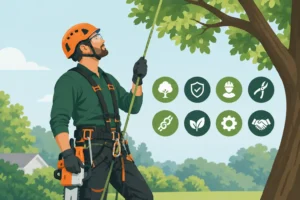
You should also ask, Are you fully insured for this type of work? Tree service is high-risk work, and this is not the place for vague answers. A legitimate company should carry liability coverage and workers’ compensation. If a contractor is injured on your property or damages a structure, fence, driveway, or neighboring yard, insurance matters.
Another key question is who will actually be doing the work. Some companies send an experienced estimator and then subcontract the job to a different crew. That is not always a problem, but you should know who is responsible on site and who is supervising the work. If an arborist is involved in the estimate, ask whether that same level of oversight continues through the job.
Questions that reveal experience and judgment
Not every tree should be removed, and not every trim recommendation is a good one. Ask, Why are you recommending removal, pruning, or stump grinding in this case? The answer should be specific to the tree and the site. A solid contractor might point to decay, poor branch structure, storm damage, root issues, interference with a foundation, or repeated sucker growth from an old stump.
If they cannot explain the reasoning clearly, keep looking. Good tree work is not guesswork.
It also helps to ask whether there are risks that could change the job once work begins. Hidden cavities, embedded metal, unstable trunks, tight backyard access, and extensive root spread can all affect labor, timing, and equipment needs. An honest estimate should mention possible unknowns instead of pretending every job is straightforward.
If your property has mature trees you want to preserve, ask what steps they will take to protect nearby lawn, plantings, hardscape, and healthy root zones. Heavy equipment can do real damage if it is not used carefully. The right company will think through access routes, machine placement, and cleanup from the start.
Best questions for tree service estimates about cleanup
Cleanup is where estimate differences often show up. Ask, What will the property look like when the job is complete? That question gets beyond price and into standards.
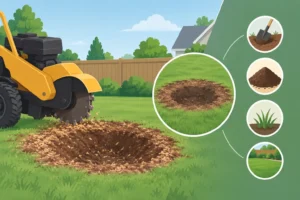
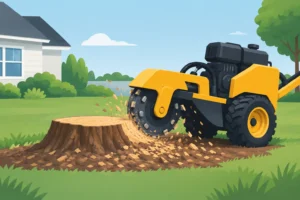
Will brush and logs be removed? Will sawdust from stump grinding be hauled away or left for backfill? Will tire tracks be repaired if conditions are soft? Will the crew blow off the driveway, sidewalk, patio, and street? If they are removing a stump, ask how deep they grind and whether visible surface roots are part of the work.
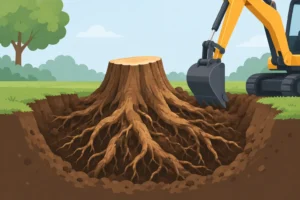
For many homeowners, the stump and roots are the real issue. A stump left behind can keep a yard unusable, attract insects, create mowing headaches, and keep root systems active longer than expected. If roots are lifting walkways or interfering with replanting, ask whether the company can remove those roots in a meaningful way or if they only do surface grinding.
Questions about timing, permits, and coordination
Ask when they can schedule the work and how long the job should take. Weather, ground conditions, crew size, and equipment availability all affect timing, so some flexibility is normal. What you want is a realistic window and good communication.
If the tree is near a road, power line, shared property line, or protected area, ask whether permits or utility coordination may be required. A seasoned local contractor should know when a job needs extra steps and when it does not. That local knowledge can save time and avoid problems.
You should also ask what happens if weather delays the work or if site conditions change. This gives you a sense of how the company handles scheduling pressure. The right answer is not always the fastest one. Sometimes waiting for safer conditions is the better decision.
How to compare estimates fairly
When you get more than one estimate, do not compare only the final number. Compare the scope, the method, the insurance, the cleanup standard, and the experience behind the recommendation. One price may include full debris removal, stump grinding, and careful sectional removal near structures. Another may cover only basic cutting and haul-off.
If one estimate is dramatically lower, ask why. Sometimes there is a legitimate reason, like easier access or less equipment. But sometimes a low bid means corners will be cut. In tree work, shortcuts usually show up in safety practices, site protection, or cleanup.
It is also worth paying attention to how the estimate is delivered. Was the contractor on time? Did they walk the site carefully? Did they answer questions directly? Did the written estimate match the conversation? Professionalism during the estimate stage usually carries into the job itself.
Red flags to watch for during the estimate
Be cautious if someone pressures you to decide on the spot, cannot explain the plan, avoids insurance questions, or gives a price without looking closely at the tree and the work area. Another red flag is a contractor who treats every tree as a removal candidate without discussing condition, risk, and alternatives.
You should also be careful with vague promises like we will clean it up good or we will take care of the roots. Those phrases sound fine until the crew leaves brush behind, grinds only a few inches deep, or leaves major roots that still interfere with the yard. Specific answers are better than friendly but unclear ones.
What a strong estimate should leave you with
A good tree service estimate should leave you with a clear picture of the work, the expected outcome, and who is responsible for each part of the job. You should know whether the tree is being removed or pruned, whether the stump and roots are included, how the crew will protect your property, and what cleanup is part of the price.
For property owners in Connecticut, especially around older neighborhoods with mature trees and tighter lot lines, experience counts. Jobs near homes, stone walls, driveways, septic areas, and established landscaping require more than basic cutting skills. They require judgment.
That is why asking the right questions matters so much. A solid company will not be annoyed by them. They will welcome them, because good contractors know an informed customer is usually the one who values safe work, clean results, and accountability. Stumpbuster LLC has built its reputation around exactly that kind of straightforward conversation.
Before you approve any tree work, slow the estimate process down just enough to ask better questions. A few extra minutes in the yard can save you from a bad hire, a messy cleanup, or a job that does not really solve the problem.