A fruit tree can look full and green yet still produce small, poor-quality fruit because its energy is tied up in crowded, shaded branches. Knowing how to prune fruit trees helps direct that energy where it counts: healthy structure, good airflow, and fruit that can actually ripen.
For Connecticut homeowners, pruning is usually a yearly job, not a one-time fix. A few well-placed cuts made at the right time are better than aggressively cutting back a neglected tree all at once. The goal is not to make the tree look perfectly symmetrical. The goal is a strong, open framework that gets sunlight through the canopy and can carry a crop without splitting.
Start With the Right Pruning Season
Most established apple, pear, plum, and peach trees are pruned during dormancy, generally from late winter into early spring before buds fully open. In New Haven County, that often means late February through March, depending on weather conditions and the tree species.
Dormant pruning makes the branch structure easier to see and avoids removing active leaves that help feed the tree. It also encourages vigorous growth when spring arrives. Wait until the worst hard freezes have passed when possible, particularly for stone fruit such as peaches, nectarines, cherries, and plums.
Summer pruning has a place, but it is more selective. It is useful for removing water sprouts, controlling a tree that is growing too tall, or opening dense areas that are blocking sunlight from fruit. Because summer cuts reduce the tree’s food-making leaf area, use them lightly. Heavy summer pruning can stress a tree during hot, dry conditions.
Dead, broken, diseased, or hazardous branches are the exception. Remove those when you see them, provided the work can be done safely.
Before You Cut, Know What You Are Looking At
The best way to prune fruit trees is to make every cut serve a purpose. Stand back first and look at the entire tree from several angles. You are looking for a central structure with well-spaced scaffold limbs, not a thicket of branches competing for the same space.
Start by identifying the branch collar, the slightly swollen area where a branch joins the trunk or a larger limb. Cuts should be made just outside this collar. Do not leave a long stub, which can decay, and do not cut flush against the trunk, which removes the tree’s natural protective tissue.
Use clean, sharp hand pruners for small shoots, loppers for medium branches, and a pruning saw for larger limbs. Disinfect tools between trees, and especially after cutting diseased wood. Dull tools crush bark and leave rough wounds that are slower to seal.
For anything above safe ground reach, do not improvise with a ladder, pole saw, or chainsaw. Fruit trees can have hidden weak limbs, uneven ground beneath them, and branches that shift as weight comes off. That is where a professional tree crew is the safer choice.
Remove Problems First
Work from obvious problems toward fine shaping. Remove dead, damaged, rubbing, and diseased branches before deciding which healthy growth to keep. This clears your view and keeps you from making unnecessary cuts.
Pay close attention to branches that cross through the middle of the canopy. As they rub in wind, bark can wear away and create an entry point for insects and decay. Choose the better-positioned branch and remove the other.
Also remove suckers growing from the base of the tree or from roots, along with most water sprouts. Water sprouts are fast, upright shoots that often appear on the top of limbs or near old pruning cuts. They rarely produce useful fruit, shade the canopy, and pull energy from the tree’s productive wood.
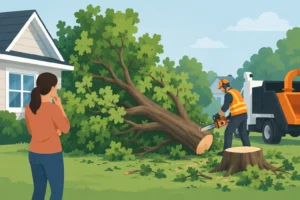
If a major branch is dead, cracked, or hanging over a roof, driveway, walkway, or service line, the job has moved beyond ordinary orchard pruning. Protecting people and property comes first.
Open the Canopy Without Hollowing Out the Tree
After removing problem growth, thin the remaining branches so light and air can move through the tree. A practical test is whether sunlight can reach much of the interior during the growing season. You should be able to see open spaces between the main limbs, but the tree should not look stripped bare.
Thin by removing an entire branch back to its point of origin, or back to a healthy side branch. This is different from heading cuts, which shorten a branch by cutting it back to a bud or side shoot. Thinning cuts are often the better option for crowded mature trees because they reduce density without triggering as much aggressive regrowth.
Heading cuts are useful when a young tree needs branching or when a limb must be shortened to keep it away from a structure. Make the cut just above an outward-facing bud. The bud below the cut usually becomes the new direction of growth, so its position matters.
A common mistake is removing too much in one season. As a general rule, do not take more than about one-quarter of a mature tree’s live canopy in a year. A badly overgrown tree may need corrective pruning spread over two or three seasons. Heavy cuts can cause a burst of water sprouts and leave the tree more stressed than improved.
Train Young Trees Early
Young fruit trees are easier to shape than mature ones. The structure you establish in the first few years determines how well the tree handles fruit weight, snow, wind, and future pruning.
Apple and pear trees are commonly trained to a central leader. That means keeping one main upright trunk with tiers of well-spaced side limbs. Remove or shorten competing upright leaders before they become large, and favor branches that grow outward at a broad angle. Narrow, upright branch angles are more likely to split under a heavy crop.
Peaches, nectarines, and many plums are often trained to an open-center form. Instead of a single central leader, the middle is kept open like a vase, with several strong main limbs growing outward. This lets sunlight reach lower fruiting wood and makes harvesting easier.
Do not expect one pruning method to fit every tree. Apple and pear trees bear fruit on long-lived spurs, while peach trees produce fruit mainly on one-year-old shoots. Peaches generally need more annual renewal pruning because older wood becomes less productive. If you are unsure of the species or variety, identify it before making major cuts.
Make Clean Cuts on Larger Limbs
Large branches deserve a slower approach. A heavy limb can tear bark down the trunk if it breaks before the final cut is complete. Use the three-cut method to prevent that damage.
First, make a small undercut several inches out from the trunk. Next, make a top cut a little farther out to remove the weight of the limb. Then make the final cut just outside the branch collar. This leaves a clean wound the tree can seal naturally.
Do not apply wound paint or tar to routine pruning cuts. Trees seal wounds through their own biological process, and coatings can trap moisture or interfere with that process. Clean cuts, good timing, and a healthy tree are the better approach.
Know When to Call a Tree Professional
Routine pruning from the ground is manageable for many homeowners. It becomes risky when a fruit tree is tall, neglected, storm-damaged, growing near utility lines, or carrying large dead limbs. A tree may also have internal decay that is not obvious until a branch fails.
Stumpbuster LLC has served New Haven County properties since 1985, and arborist-led evaluation can help distinguish a fruit tree that needs careful restoration pruning from one with structural problems that require a different plan. For commercial properties, shared driveways, and trees near buildings, insured professional work also helps reduce the risk that comes with overhead cutting.
Give the Tree Time to Respond
After pruning, rake up fallen fruit, leaves, and diseased cuttings rather than leaving them beneath the tree. This is especially helpful where fungal disease or insect pressure has been a recurring problem. Water the tree during dry periods, keep mulch a few inches away from the trunk, and avoid piling fertilizer on a stressed tree just because it was pruned.
Then watch what happens over the next growing season. Good pruning is not judged only by how the tree looks on the day of the cut. It shows up in stronger branch growth, better light through the canopy, fewer broken limbs, and fruit that has room to develop. When a cut involves height, heavy wood, or anything close to your home, let safety make the decision for you.