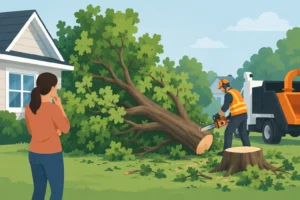
You cleared the tree, but the hard part may still be sitting in the ground. If your goal is new grass, a shrub bed, or another tree in the same area, a real guide to stump removal for replanting starts with one simple fact – not every stump removal method leaves the site ready to grow.
That matters on Connecticut properties where yard space is limited, roots run close to patios and driveways, and homeowners want the job done once, not twice. A stump that is only shaved down can still leave major roots, poor soil, and buried wood that interferes with planting. If you want the area to look good and grow well, the removal plan has to match what you intend to plant next.
Why stump removal for replanting is different
Removing a stump just to get rid of an eyesore is one thing. Removing it so the space can support healthy new planting is another. Replanting puts more demands on the site. You need usable soil depth, fewer competing roots, proper grading, and enough room for new roots to establish.
A lot of property owners assume stump grinding and replanting are always a direct one-two step. Sometimes they are. Sometimes they are not. It depends on the size of the original tree, the species, how much of the root flare remains, and whether you are planting turf, shallow-rooted shrubs, or a replacement tree in nearly the same footprint.
If the old stump was from a large maple, oak, or other mature tree, the remaining root system can occupy more space than expected. Even after the visible stump is ground down, those structural roots may still affect drainage, settling, and planting depth. That does not mean the site cannot be reused. It means the work needs to be planned with the end use in mind.
The two main approaches
Stump grinding
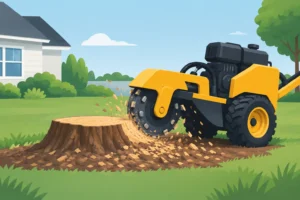
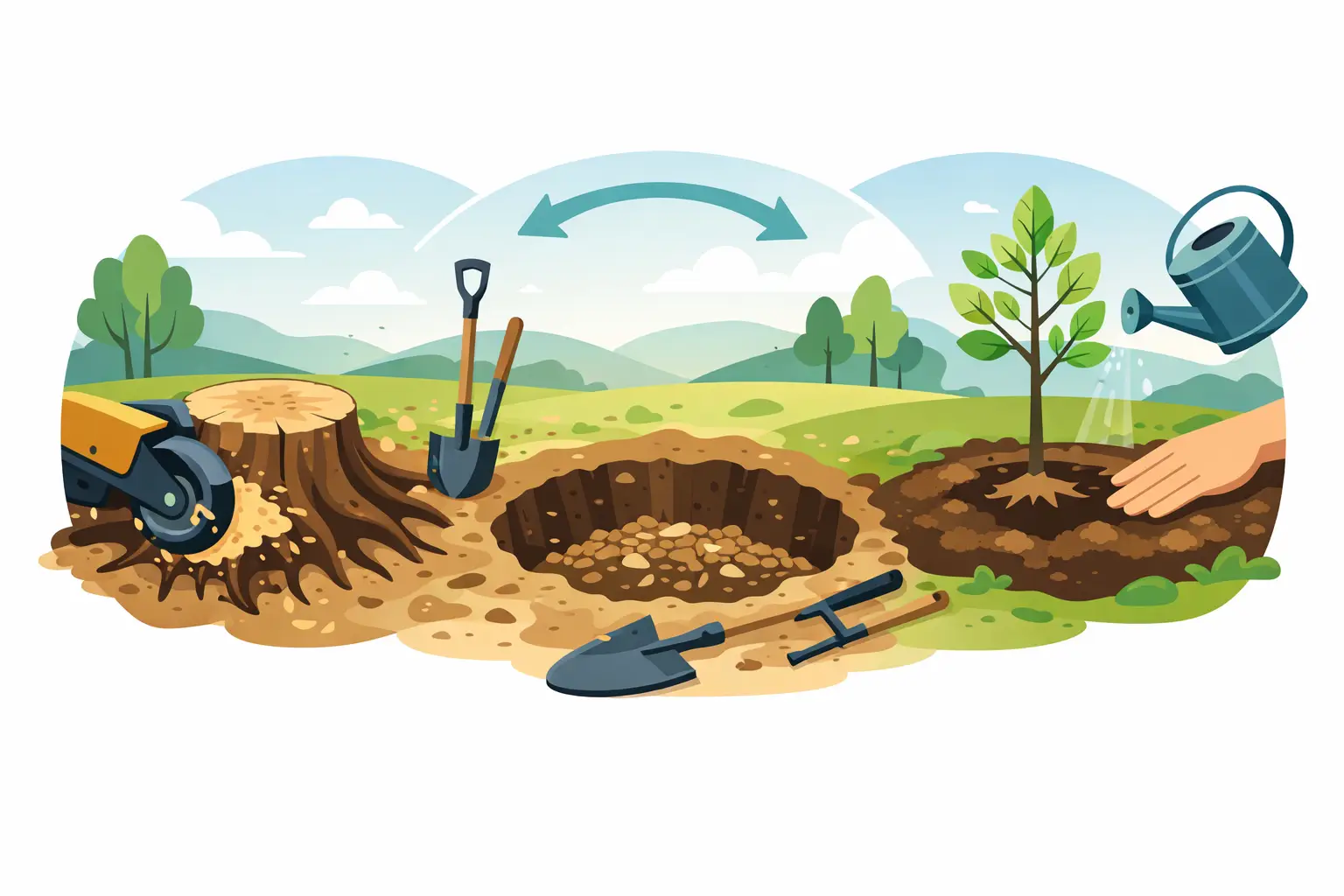
Stump grinding is the most common approach because it is efficient, less disruptive, and usually the right choice when the goal is to restore usable yard space. The stump is mechanically ground below grade, and the surface area can then be backfilled and leveled.
For many replanting jobs, this is enough. If you want grass, groundcover, or smaller ornamental plantings, grinding is often the practical option. It removes the visible obstruction, improves appearance, and avoids the large excavation that comes with full extraction.
The trade-off is that grinding does not usually remove the entire root system. Larger roots remain underground and break down over time. In some cases that is fine. In others, especially if you want to plant a new tree in the exact same spot, it can create problems.
Full stump and root removal
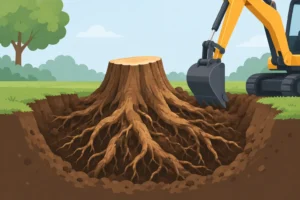
Full removal is more aggressive. It involves extracting the stump and more of the root mass, often with specialized equipment. This creates a cleaner planting zone and more open soil volume for future roots.
The benefit is obvious when replanting needs more depth and fewer underground obstructions. The downside is that it is more invasive. There is more disturbance to the surrounding lawn or landscape, and access matters. Near fences, septic areas, walks, and foundations, the best method depends on how much room there is to work safely.
On some properties, a deeper, cleaner removal makes far more sense than repeated patchwork later. That is especially true when roots have surfaced, the stump sits in a future garden bed, or the new planting needs a stable base instead of decaying wood under the soil.
A practical guide to stump removal for replanting by planting type
If you are planting grass
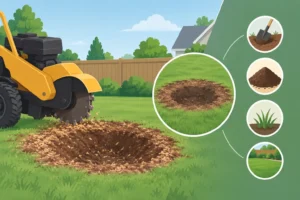
Grass is the easiest thing to re-establish after stump work, but even then the site has to be handled correctly. Fresh grindings are not topsoil. If they are left piled in the hole, the area can sink as the wood breaks down, and seed may struggle.
A good setup usually means removing excess chips, adding clean soil, and grading the area to match the surrounding yard. Once that is done, seeding or sod has a much better chance of taking evenly.
If you are planting shrubs or a garden bed
Shrubs and perennial beds need better soil conditions than turf. If the original stump was shallow-ground and the area is packed with wood debris, root growth can be uneven. Plants may survive, but they may not thrive.
This is where cleanup depth matters. The more the old stump material is cleared out and replaced with usable soil, the better the bed will perform. You also want to avoid planting directly into a pocket of decomposing chips because nitrogen can temporarily get tied up as the wood breaks down.
If you are planting a new tree
This is where homeowners most often run into trouble. Replacing one tree with another in exactly the same spot sounds neat and simple, but underground conditions rarely cooperate. Old roots can block digging, make the new root ball sit too high, or leave the replacement tree competing in poor soil.
Often, the better move is to shift the new tree several feet away from the original stump site if the property allows it. If that is not possible, more extensive stump and root removal may be needed. The right answer depends on species, spacing, and what is below grade.
Timing matters more than most people think
You do not always want to replant the same day the stump comes out. In some cases you can. In others, giving the area a little time makes for a better result.
After grinding, the site may need cleanup, added soil, and a chance to settle. If there is a lot of buried woody material, waiting before installing a more permanent planting can help avoid future low spots. For lawn areas, that process is usually straightforward. For trees and larger shrubs, it pays to be more careful.
Season also plays a role. In New Haven County, spring and fall are usually the best windows for replanting because temperatures are milder and moisture is more dependable. Summer planting can work, but only if watering is consistent. Winter removals may make sense for access or scheduling, while actual replanting waits for better soil conditions.
What can go wrong when stump removal is rushed
Most problems come from treating stump removal and replanting as separate jobs when they really affect each other. The area gets ground out, chips are pushed back in, a plant goes on top, and a few months later the spot sinks or the plant struggles.
Another common issue is underestimating the root spread. A stump may look small at the surface but have heavy lateral roots extending well beyond the planting zone. If those roots interfere with digging, surface grading, or future hardscape, partial work may not solve the real problem.
There is also the safety side. Large stumps near buildings, retaining walls, utilities, and paved areas are not a weekend equipment rental project for most property owners. The work has to be controlled so surrounding structures and landscape features are not damaged.
How to tell which method is right for your property
Start with the end goal. If you want the area cleaned up for lawn use, standard grinding and proper backfilling are often enough. If the site is being turned into a planting bed, you may need more material removed and better soil prep. If you want to install a new tree close to the old one, deeper root removal may be the smarter investment.
Tree size matters. So does species. Some root systems are more extensive and more stubborn than others. Access matters too. Tight backyards in places like Hamden, Branford, or Wallingford may limit equipment options, while open commercial properties may allow a more complete extraction.
This is where experienced evaluation saves time. An arborist-led crew can look at the species, stump size, root flare, grade, nearby structures, and your replanting plans and recommend the approach that fits the site instead of giving a one-size-fits-all answer.
For tougher root systems, specialized equipment can make a big difference in how thoroughly the area is cleared. That is one reason property owners across New Haven County call Stumpbuster LLC when they need more than a quick surface grind. Cleaner removal below grade often means fewer surprises when it is time to plant.
Soil prep is what makes the replanting succeed
Once the stump is gone, the site still needs to become a planting site. That means removing excess grindings where needed, bringing in clean soil, correcting grade, and making sure water will drain properly. If the area is being replanted with a tree or shrub, the soil should support root spread instead of trapping the plant in leftover debris.
This part is easy to overlook because it does not get the same attention as the removal itself. But it is often the difference between a spot that simply looks cleared and one that is actually ready to grow.
If you are planning stump removal because you want to reclaim yard space, improve curb appeal, or plant something new, the best next step is to treat removal and replanting as one project. When the site is evaluated with the final result in mind, the work tends to go faster, the planting performs better, and you avoid coming back later to fix what should have been handled the first time.