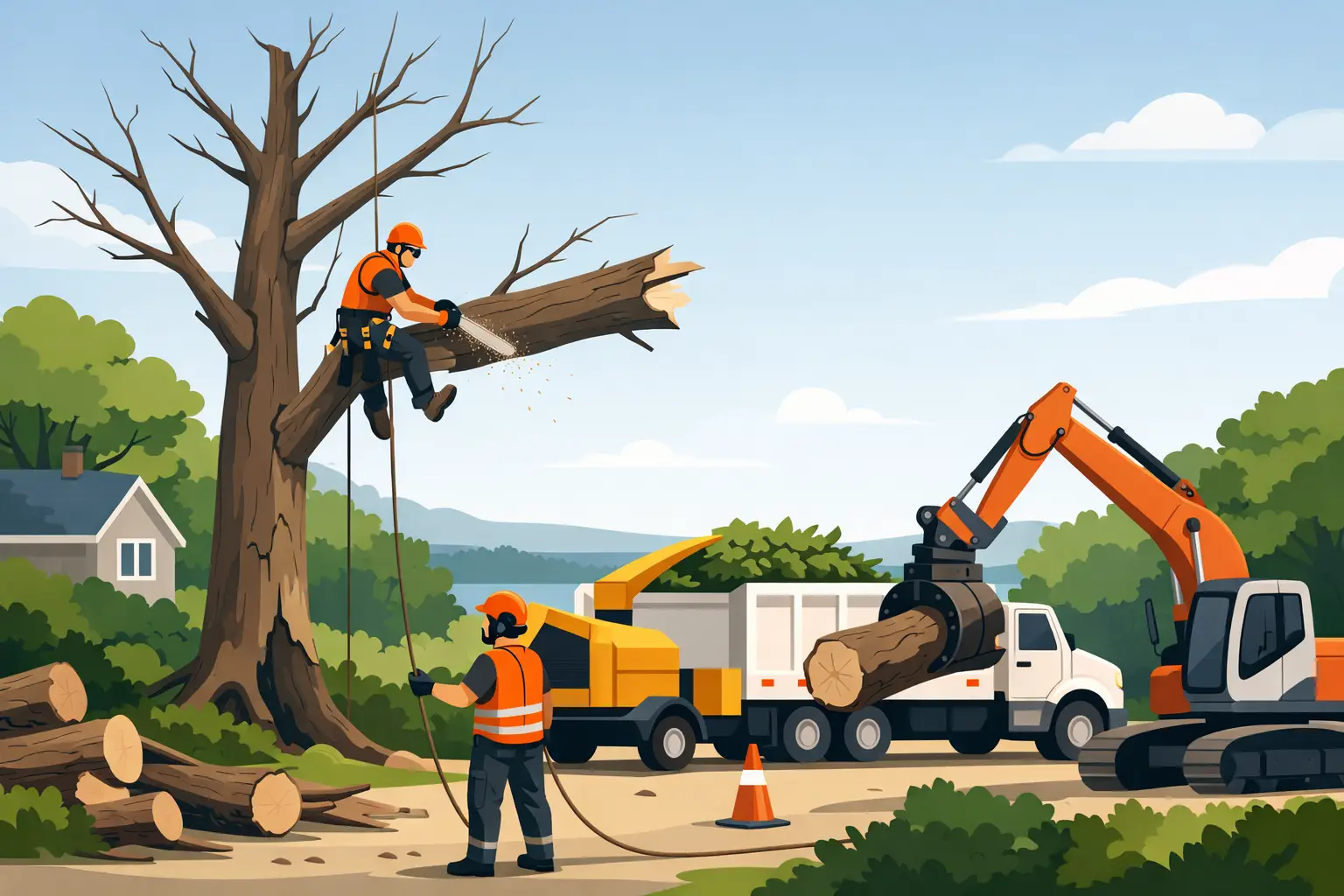
A mature oak can look solid from the street while its failure risk is building where no one can see it. This example of hazardous oak removal shows why a leaning tree near a home, driveway, or utility line calls for more than a chainsaw and a quick cut.
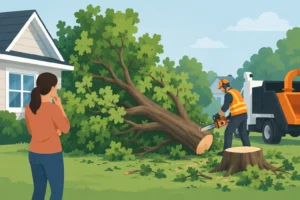
Consider a large red oak on a residential lot in New Haven County. The tree stood roughly 70 feet tall, with a broad canopy extending over part of the roof, a paved driveway, and a neighbor’s fence. After a period of heavy rain and wind, the homeowner noticed fresh cracks in the soil near the base, dead limbs in the upper canopy, and a visible lean toward the house.
None of those signs automatically means a tree will fall that day. Together, however, they are enough to treat the oak as a serious hazard and have it evaluated by an experienced tree professional.
Example of Hazardous Oak Removal: The Site Assessment
Before equipment arrives, the job starts with an on-site assessment. The crew needs to understand not only what is wrong with the tree, but also what could be damaged if a limb or section moves unexpectedly.
In this case, the oak had several concerns: a root plate beginning to lift on one side, decay around an old pruning wound, and a heavy lead extending over the home. The ground was soft from recent rain. That mattered because saturated soil can reduce a compromised tree’s holding strength, especially when a mature oak already has a lean.
The assessment also included the work zone. The driveway had to be kept clear of vehicles, the neighbor’s fence needed protection, and the crew had to account for overhead service lines nearby. A hazardous removal plan is never just about dropping a tree into an open yard. On many Connecticut properties, there is no open yard large enough for that approach.
The safest choice was a controlled dismantling removal. Rather than felling the oak in one piece, the crew would remove branches and trunk sections from the top down, lowering material into a defined landing area.
Why a Full-Tree Felling Was Not the Right Call
A straight felling cut can be efficient when a healthy tree has enough clear space around it. It is not the right method for every removal. With a compromised oak leaning toward a structure, the condition of the wood and roots can make the tree less predictable during cutting.
A large oak also carries a great deal of weight well beyond its trunk. A single major limb can be long, heavy, and positioned directly over a roof, garage, fence, or landscaped bed. Cutting it loose without control can cause damage even if the trunk itself remains standing.
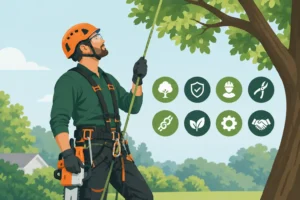
For this job, the crew established a restricted work area and used proper rigging to control sections as they came down. Branches were removed first to reduce weight and create a safer path for the climber. Larger limbs were cut in manageable pieces and lowered with ropes rather than allowed to fall freely.
This process takes more time than a simple open-area felling job. It also greatly reduces the chance of damage to the property below. That is the trade-off homeowners should expect when a hazardous tree is close to valuable structures: safe, controlled work is more involved because the site requires it.
Removing the Oak in Controlled Sections
Once the outer canopy was reduced, the crew worked down through the main leaders and trunk. Each section was sized according to its location, weight, and the available landing zone. The goal was to keep every cut predictable and every piece under control.
The removal sequence matters. Taking too much weight from one side of a leaning or decayed tree can change its balance. Leaving the wrong limb in place can interfere with rigging or create an unnecessary hazard for the crew. This is where arborist knowledge and field experience make a practical difference.
The final trunk sections were lowered away from the house and driveway. Once the tree was reduced to a safe height, the remaining base was cut close to ground level. All wood, brush, and debris were removed from the work area so the property was not left with a pile of hazardous material or a damaged-looking yard.
For a tree like this, attempting removal without training, climbing equipment, rigging knowledge, and adequate insurance is a major risk. Even a homeowner with a chainsaw should not try to manage a large leaning oak near a home. The danger is not limited to the tree falling. Falls from height, kickback, suspended limbs, hidden decay, and contact with utility lines can all turn a small mistake into a serious emergency.
Stump and Root Cleanup After Removal
Removing the visible tree solves the immediate overhead hazard, but the stump can still affect how the property is used. In this example, the homeowner wanted to expand the driveway-side planting area and eliminate a tripping obstacle near the lawn.
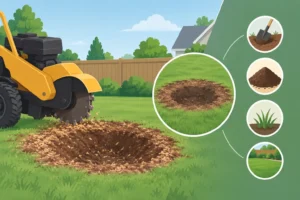
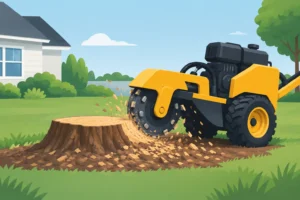
Stump grinding can reduce the stump below grade and allow the area to be covered with soil and seed. For many properties, that is the practical option. If roots are interfering with a future patio, lawn restoration, drainage work, or new planting, deeper root removal may be worth considering.
The right approach depends on the site and the homeowner’s plans. Full root extraction is not necessary for every stump, and aggressive excavation near utilities, foundations, or established landscaping may not be appropriate. A professional evaluation should consider what is beneath the surface before deciding how far the cleanup should go.
Stumpbuster LLC uses its Plowrake root removal system when a property needs a more thorough approach to old stump and root systems. That can help restore usable yard space where surface roots and remaining wood would otherwise continue to cause problems.
Warning Signs That Can Make an Oak Hazardous
Healthy, mature oaks are valuable trees, and removal should not be the automatic answer to every dead limb or slight lean. Pruning, cabling, monitoring, or other care may be appropriate when the tree is structurally sound. But property owners should take certain changes seriously, especially after storms.
Watch for a new or increasing lean, exposed or heaving roots, deep cracks in the trunk, large dead branches, mushrooms or decay at the base, cavities, splitting crotches, or soil lifting around the root area. A sudden change in canopy color or leaf loss can also point to stress, though it does not by itself prove that removal is necessary.
Location changes the urgency. A declining oak at the edge of a wooded lot may allow time for a careful evaluation. The same oak hanging over a child’s play area, parked vehicles, roof, power service, or busy commercial entrance deserves prompt attention.
If a tree is touching or has brought down a power line, stay away from the area and contact the utility provider or emergency services. Do not attempt to move branches or remove the tree yourself.
What a Good Removal Plan Should Leave Behind
A professional hazardous oak removal should leave the property safer, cleaner, and ready for its next use. That means protecting structures during the work, removing brush and logs as agreed, handling the stump based on the owner’s plans, and avoiding unnecessary damage to the surrounding lawn and landscape.
It also means being honest about the condition of the tree. Sometimes removal is clearly the safest recommendation. Other times, selective trimming or ongoing monitoring is enough. A dependable arborist-led company will explain the reason for the recommendation and the work needed to complete it safely.
If a mature oak on your New Haven County property has started to lean, shed large limbs, or show signs of root failure, do not wait for the next storm to make the decision for you. A timely site visit and a clear removal plan can protect your home, your yard, and the people who use it.