A driveway usually does not fail all at once. First you notice a small lift at one edge, then a crack that keeps widening, then a section that starts holding water after every rain. If you are asking, can tree roots damage driveway surfaces, the short answer is yes – and in many cases, they already are by the time the damage becomes obvious.
Around New Haven County, we see this most often with mature trees planted years ago when the driveway was smaller, the tree was younger, and nobody expected the root flare to spread as far as it did. What looks like a concrete or asphalt problem is often a root problem underneath.
Can Tree Roots Damage Driveway Areas? Yes, but It Depends
Tree roots can crack, lift, and distort driveways, but not every tree near pavement causes trouble. A lot depends on the tree species, its age, the distance from the driveway, the soil conditions, and the type of driveway itself.
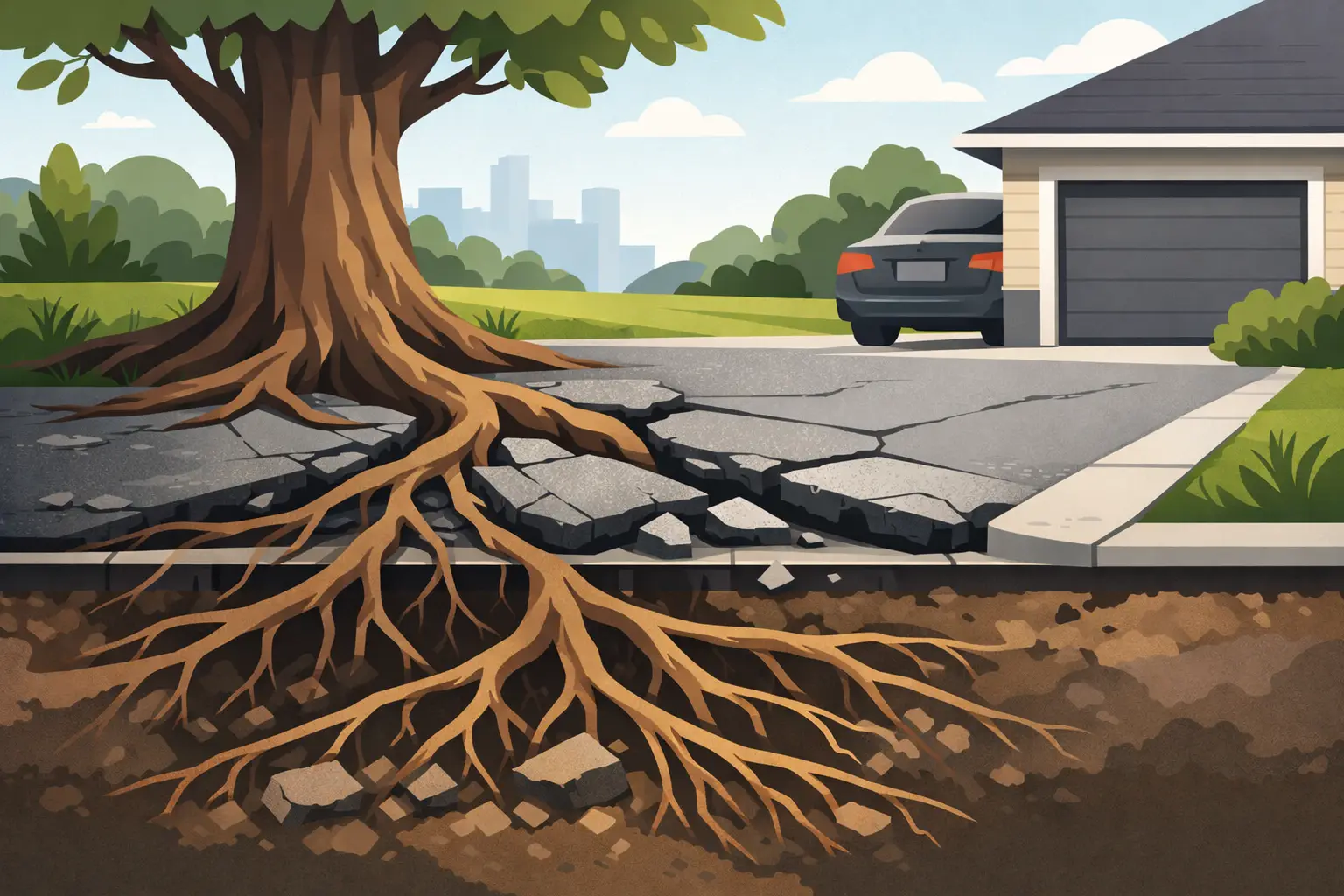
Concrete tends to show heaving and separation clearly because it is rigid. Asphalt has a little more give, but it can still buckle, split, or develop uneven low and high spots as roots expand below it. Paver driveways may shift out of level or spread apart. In all three cases, the root is rarely punching straight through the material. More often, the root is enlarging underneath and forcing the surface upward over time.
That is why the damage can seem sudden even though the process has been going on for years. A driveway may look fine one season and noticeably uneven the next, especially after freeze-thaw cycles in Connecticut make existing movement worse.
Why Roots Lift Pavement
Most tree roots stay in the upper portion of the soil where oxygen and moisture are easier to reach. That means they often grow directly under walkways, patios, and driveways instead of diving deep below them.
As roots thicken, they displace the soil and put pressure on whatever is above. If the base under the driveway was already thin, compacted poorly, or weakened by age, the surface becomes even more vulnerable. Water also plays a role. Once a crack forms, water gets in, washes out fines, and weakens the structure. Then winter freezing expands the problem.
This matters because people often blame the tree alone when the real issue is a combination of root growth and a driveway that had little room for movement. The tree is still the trigger, but the extent of the damage depends on the whole site.
Which Trees Cause the Most Problems
Some species are more likely to create surface root issues than others. Fast-growing shade trees are common culprits, especially older maples, silver maples, willows, poplars, and certain oaks. Trees with aggressive, wide-spreading root systems tend to create the biggest conflicts with pavement.
That said, almost any large mature tree can damage a driveway if it is planted too close. Even a healthy, well-maintained tree can create trouble simply because roots need space. Homeowners are often surprised by how far roots extend. In many cases, the root system reaches well beyond the branch spread.
Age also matters. A young tree near a driveway may look harmless for years. Then the trunk diameter increases, the structural roots enlarge, and the pressure starts to show up in the pavement.
Warning Signs Before the Driveway Gets Worse
The earliest signs are usually subtle. One slab edge may sit slightly higher than the next. A long hairline crack may form where there was none before. Asphalt may look pushed up in a narrow ridge. Pavers may start rocking underfoot or drifting out of line.
You may also notice roots visible at the soil surface along the driveway edge, or a tree base that seems to be expanding toward the pavement. Drainage changes are another clue. If a driveway starts collecting water in places that used to drain normally, hidden root movement may be changing the grade.
These are worth paying attention to because the problem rarely stays cosmetic. Uneven pavement becomes a trip hazard, snow removal gets harder, and vehicle wear increases when tires repeatedly hit lifted sections.
Can You Cut the Roots and Keep the Tree?
Sometimes yes, sometimes no. This is where experience matters.
Cutting a root that is damaging a driveway may relieve the pressure, but root removal is not automatically safe for the tree. Large structural roots close to the trunk are critical for stability and health. Remove too much, or remove roots on one side without understanding the load and species response, and you can create a larger problem than the driveway damage you started with.
There is also the issue of regrowth. In some cases, cutting roots provides only temporary relief if the tree remains in place and conditions still favor root expansion into the same area. If the driveway is repaired without addressing the right roots, the damage often returns.
A proper assessment looks at the size and species of the tree, the distance from the trunk, the size of the roots involved, the condition of the canopy, and the value of the tree compared with the cost of ongoing hardscape repair.
When Root Removal Makes Sense
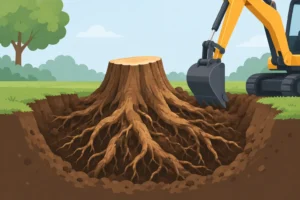
Root removal makes sense when the roots are clearly causing pavement failure and can be removed without creating unacceptable risk to the tree or surrounding property. It can also be the right move after tree removal, when leftover roots and stump material continue to interfere with grading, new pavement, lawn restoration, or future use of the space.
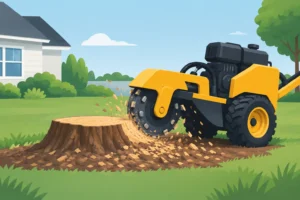
This is especially common with old stump sites near driveway edges. Even after a tree is cut down, remaining roots can continue to complicate excavation and replacement work. In those situations, more thorough root removal often saves money on the back end by giving the new surface a cleaner, more stable base.
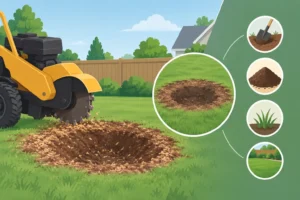
For deeper or more extensive root systems, specialized equipment matters. Stumpbuster LLC has handled this kind of work across local properties since 1985, including difficult stump and root extraction where a basic stump grind is not enough to clear the area properly.
When the Better Answer Is Tree Removal
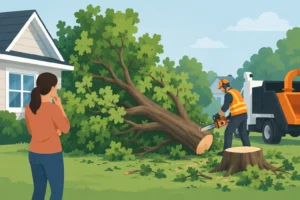
Not every tree near a damaged driveway should be removed, but some should. If the tree is already declining, structurally compromised, crowding the house or utilities, or causing repeated hardscape damage, removal may be the more practical long-term solution.
That is especially true when the root responsible is too large or too close to the trunk to cut safely. In that case, trying to save both the tree and the driveway can leave you stuck with continuing repairs and increasing risk.
For homeowners, this usually comes down to cost, safety, and future use of the property. If you plan to replace the driveway, expand parking, or improve drainage, it often makes sense to solve the tree issue first instead of rebuilding around a known problem.
How to Prevent Future Driveway Damage
The best prevention starts before damage appears. If you are planting new trees, give them enough room from driveways and foundations. Choose species with mature size in mind, not just what looks good at planting time.
If you already have mature trees near pavement, regular inspection helps catch issues early. Small shifts are easier to address than major upheaval. In some cases, selective root work, careful pruning, or changes to the hardscape plan can reduce future conflict.
For replacement driveways, base preparation matters. A stronger sub-base and a design that accounts for nearby root zones can improve lifespan, though it will not stop a large root from exerting pressure forever. There is no one-size-fits-all fix. The right approach depends on whether the priority is preserving the tree, preserving the driveway, or balancing both as long as reasonably possible.
What Property Owners in Connecticut Should Do Next
If your driveway is lifting, cracking, or shifting near a mature tree, do not assume it is just old pavement. The surface damage may be the visible part of a larger root issue underneath. The longer it is left alone, the more expensive the repair usually becomes.
A direct site evaluation is the smart next step. You want to know which roots are involved, whether the tree can be preserved safely, and what kind of removal or repair work will actually solve the problem instead of covering it up for a year or two.
A good contractor should be able to explain the trade-offs plainly. Sometimes that means targeted root removal. Sometimes it means stump and root extraction after removal. Sometimes it means accepting that the tree is worth keeping and adjusting the hardscape plan around it.
What matters is getting an answer based on the actual tree, the actual driveway, and the actual conditions on your property – not a guess from the curb. If the pavement is already moving, it is worth addressing before a minor lift turns into a major repair.