A commercial pruning example is easiest to understand when you look at the problems a property manager sees every day: low branches over parking spaces, limbs blocking signs, dark walkways, and trees growing too close to a building. Professional pruning is not simply cutting a tree back. It is planned work that makes a commercial property safer, cleaner, and easier to maintain without damaging the tree.
For businesses, apartment communities, office parks, retail locations, and managed properties in New Haven County, tree work has to solve real site problems. The work must protect pedestrians, vehicles, buildings, lighting, and utilities while preserving the mature trees that give the property shade and curb appeal.
A Commercial Pruning Example: The Property Problem
Consider a typical Connecticut office property with a row of mature maples and oaks along its entrance drive. Over several years, the trees have grown beyond the original landscape plan. Lower branches brush delivery vans. Limbs extend over visitor parking. Dense growth blocks a security light and partially hides the entrance sign from the road.
The property manager may be tempted to ask for the trees to be “cut back.” That description is understandable, but it is not specific enough for responsible tree care. A licensed arborist needs to assess each tree, identify the actual risks, and determine what can be removed without leaving weak branch stubs, bare sections, or an unbalanced canopy.
In this example, the goal is not to make every tree smaller. The goal is to create needed clearance, reduce selected hazards, improve visibility, and maintain a natural shape.
What a Proper Site Assessment Looks For
Before pruning starts, the crew should walk the property and look at how the trees interact with the site. The most urgent concern is usually public safety. Dead, cracked, hanging, or poorly attached limbs require attention before cosmetic concerns.
The assessment also considers branch height above drives, sidewalks, parking areas, loading zones, roofs, and service equipment. A branch that is harmless over a lawn can become a liability when it hangs over customer parking or a delivery route.
Tree condition matters as well. Mature trees in Connecticut can develop decay pockets, storm damage, co-dominant stems, and heavy limbs extending far from the trunk. Those conditions do not always mean removal is necessary. Often, selective pruning can reduce weight at the end of a limb, remove deadwood, and lessen the chance of failure during wind, snow, or ice.
Site access affects the work plan. Commercial properties may have cars, visitors, overhead wires, landscaping, sprinkler heads, and narrow access lanes. The pruning crew needs enough room to work safely while protecting the pavement, plantings, and daily operations.
The Pruning Plan for This Example
For the office property, the recommended work would likely combine crown cleaning, clearance pruning, and selective reduction. Each service has a different purpose, and the difference matters.
Crown cleaning removes dead, broken, diseased, and crossing branches from the canopy. This improves the appearance of the trees, but more importantly, it removes material that can fall without warning. A dead limb over a sidewalk or parked car is a preventable risk.
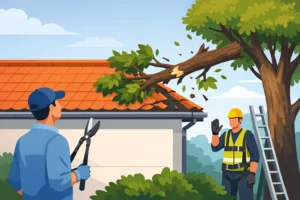
Clearance pruning raises or shortens branches that interfere with vehicles, pedestrians, signs, lighting, and structures. Along the entrance drive, lower limbs can be removed or reduced to provide appropriate clearance for delivery trucks and maintenance vehicles. Near the building, branches can be cut back from siding, gutters, and rooflines to limit abrasion and reduce pathways for squirrels and other pests.
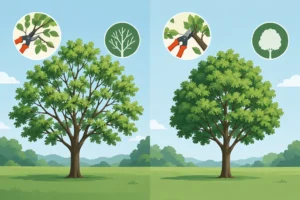
Selective reduction addresses long, heavy limbs that extend over parking areas. Rather than topping the tree or cutting all branches to the same height, the arborist makes smaller cuts back to suitable lateral branches. This reduces end weight while keeping the tree’s natural form and retaining leaf-bearing branches that support its health.
The crew may also thin limited areas around the entrance sign and security light. The purpose is visibility, not stripping out the canopy. Removing too much interior growth can stress a tree and encourage weak, fast-growing shoots. Good commercial pruning balances the property’s needs with the tree’s ability to recover.
Why Topping Is the Wrong Shortcut
When branches are too large or too close to a structure, some contractors respond by topping the tree. Topping means cutting major limbs or the main leader back to stubs or indiscriminate points. It may look like a fast solution, but it often creates more problems than it solves.
Large topping cuts can decay, and the tree often responds with clusters of weakly attached sprouts. Within a few years, those shoots may grow quickly and become more hazardous than the original branches. The tree also loses its natural structure and can look harsh or neglected in a commercial setting.
There are times when a tree has outgrown its location so severely that removal is the better long-term choice. For example, a declining tree planted too close to a building, utility line, or busy driveway may not be a good candidate for repeated heavy pruning. That decision depends on species, health, location, and risk. An experienced arborist should explain the trade-off clearly rather than treating every tree the same.
How the Work Is Performed Safely
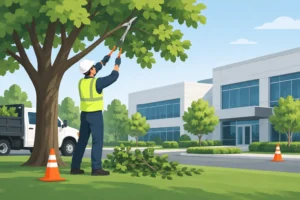
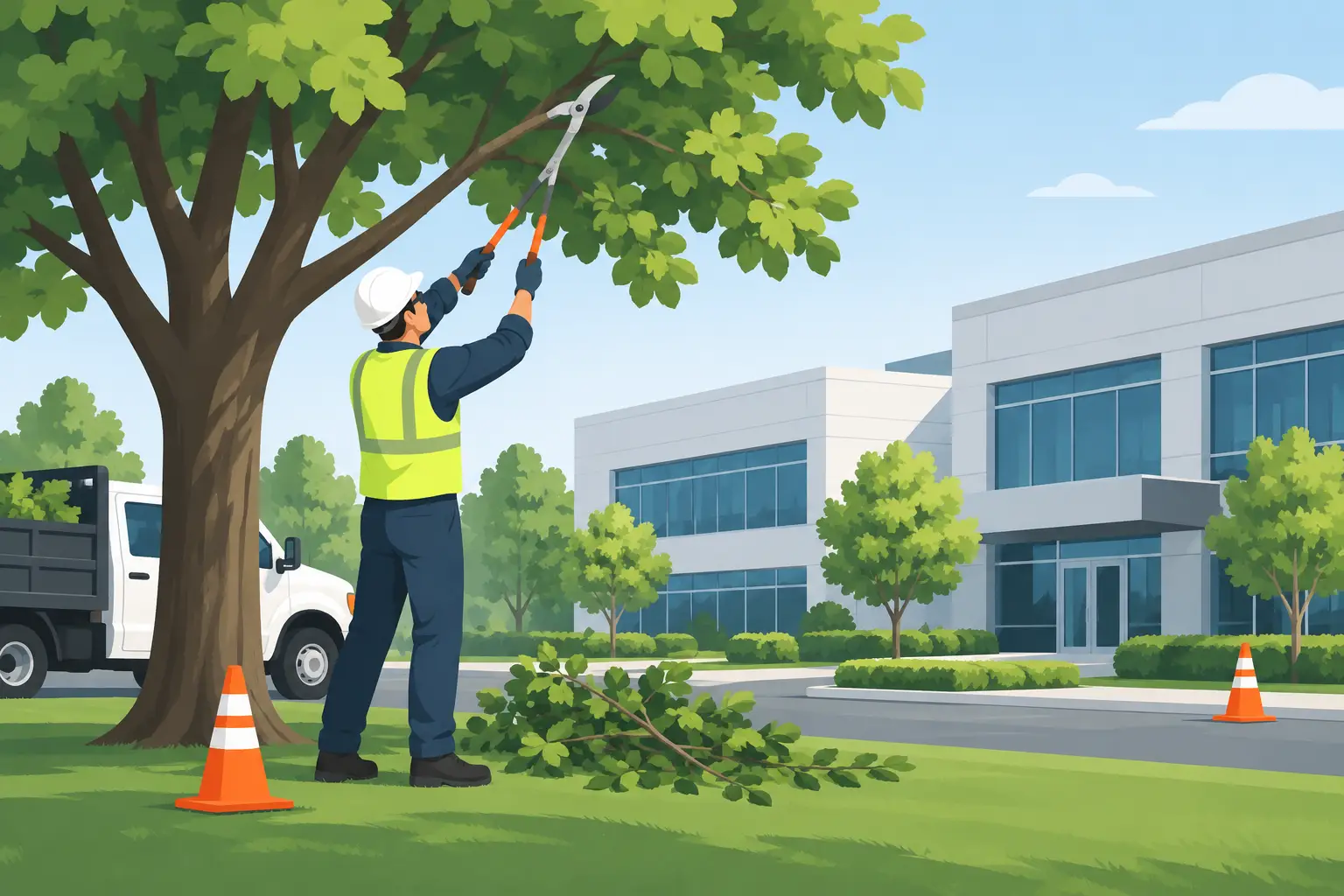
Commercial tree trimming requires more than a chainsaw and a truck. The crew needs a work zone plan that accounts for people, traffic, and property. On an active site, this can mean scheduling around customer traffic, marking off parking spaces, placing cones near work areas, and directing vehicles away from drop zones.
Climbers, aerial lifts, rigging equipment, and controlled lowering methods may be used depending on the tree and location. A branch hanging over parked cars cannot simply be dropped. It must be removed in manageable sections and lowered where necessary to avoid damage.
Insurance and training matter here. Property managers should not have to worry about whether a contractor understands safe cutting practices, has proper coverage, or will leave a mess for maintenance staff. A professional crew plans the work, protects the site, removes debris, and leaves the property orderly when the job is complete.
The Visible Results on the Property
Once this commercial pruning example is complete, the change is practical and immediate. Vehicles can use the entrance drive without branches scraping roofs or mirrors. The building sign is easier to read. Security lighting reaches the areas it is meant to cover. Customers and tenants can walk beneath the trees with fewer overhead concerns.
The improvement should not look like a row of severely cut trees. Properly pruned trees still provide shade and keep their natural character. They simply have better clearance, fewer dead limbs, and a more balanced canopy.
There is also a maintenance benefit. Keeping limbs off roofs, gutters, and building facades can reduce recurring cleanup and prevent minor tree contact from becoming a repair issue. Regular inspections allow smaller concerns to be handled before a storm turns them into an emergency call.
When Commercial Properties Should Schedule Pruning
The right timing depends on the tree species and the work required, but waiting until branches are scraping vehicles or falling onto walkways is rarely the best approach. A property should be assessed when trees begin obstructing signs or lights, growing toward structures, developing deadwood, or dropping branches after storms.
For many commercial sites, a regular pruning cycle is more efficient than occasional large-scale work. It keeps trees manageable and lets the property manager budget for maintenance instead of reacting to urgent problems. Young trees may need structural pruning to develop good form, while mature trees may need periodic crown cleaning and risk reduction.
Stumpbuster LLC has served New Haven County properties since 1985 with arborist-led tree care, insured crews, and straightforward recommendations based on what the tree and the site actually need. If your trees are affecting access, safety, visibility, or building clearance, a professional evaluation can provide a clear plan before the issue becomes more costly.