When a branch is hanging over your roof or a maple has started swallowing the front of the house, most people use pruning and trimming to mean the same thing. In real tree care, though, tree pruning vs trimming is a useful distinction because the goal of the work changes what gets cut, how much comes off, and what kind of result you should expect.
For property owners in New Haven County, that difference matters. The right cut can improve structure, reduce storm risk, and help a tree stay healthy for years. The wrong cut can leave a tree stressed, miss the real hazard, or create fast regrowth that turns into another problem next season.
Tree pruning vs trimming: the basic difference
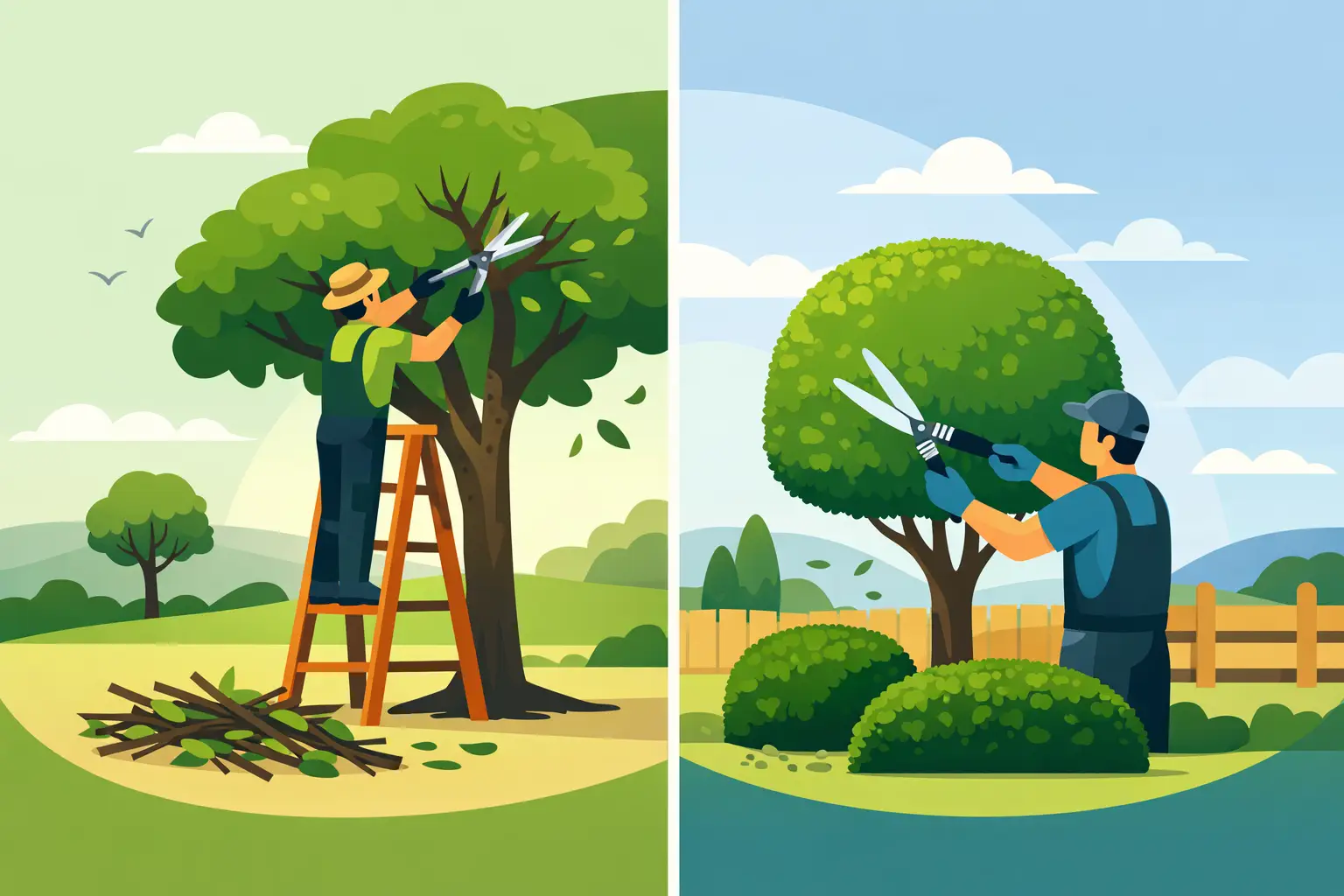
The simplest way to look at it is this: pruning is usually done for tree health, structure, and safety, while trimming is more often done for appearance, clearance, and control of overgrowth.
Pruning is selective. It focuses on dead limbs, broken branches, weak attachments, crossing limbs, storm damage, and growth that is interfering with the long-term stability of the tree. A pruning job should have a reason behind each cut.
Trimming is often broader and more appearance-driven. It may involve reducing branch spread away from a house, cleaning up overgrowth along a driveway, lifting limbs over a walkway, or reshaping a tree that has become too dense or uneven. Trimming can still improve safety, but the primary goal is often clearance and looks.
In the field, the line is not always perfect. A well-planned job may include both. A large oak near a home may need pruning to remove deadwood and weak limbs, plus trimming to pull growth back from the roof and improve clearance over the yard.
Why the difference matters on your property
If you hire someone to trim a tree when what it really needs is pruning, you may get a cleaner-looking canopy without fixing the actual risk. Dead limbs can stay in place. Structural defects can be missed. Weight may still be concentrated where the tree is weakest.
The reverse can also happen. If a tree only needs light trimming for clearance, overly aggressive pruning can remove more live growth than necessary and change the shape of the tree in a way that takes years to correct.
That is where experience counts. Mature trees around homes in Hamden, North Haven, Guilford, and similar Connecticut neighborhoods often have a mix of issues at once – storm stress, heavy shade, crowded limbs, roof encroachment, and age-related deadwood. Good tree care is not just about cutting branches. It is about knowing which cuts solve the problem without creating a new one.
When pruning is the right choice
Pruning is usually the better option when the tree’s health or structure is the main concern. If limbs are dead, cracked, rubbing together, or growing with weak angles, pruning targets those specific problems before they become failures.
It is also the right approach after storm damage. A branch may still be attached, but if it is split, twisted, or carrying hidden stress, it may need to come off cleanly to protect the rest of the tree. The same goes for limbs extending over a house, garage, fence, or parked vehicles when the concern is breakage risk rather than appearance.
You also see pruning used on younger trees to help guide future structure. That kind of work is easy to overlook because the tree does not look dangerous yet. But correcting poor branch spacing early can prevent heavier, more expensive work later.
With older trees, pruning often becomes maintenance. Removing deadwood and reducing strain in weak areas can improve safety and help the tree handle weather better. It does not make a bad tree healthy again, and it will not solve every decline issue, but in the right case it can add stability and reduce hazards.
When trimming makes more sense
Trimming is often what people actually need when the tree is healthy but has outgrown its space. Branches may be crowding a driveway, blocking windows, hanging too low over a lawn, or pushing into utility-adjacent areas on the property.
It is also common when homeowners want better light, a neater look, or more usable yard space. Overgrown ornamental trees, perimeter trees along fences, and fast-growing species near patios or sheds often fall into this category.
That said, trimming should still be done with restraint. Taking too much at once can leave a tree thin, stressed, or lopsided. It can also trigger aggressive regrowth, which means the tree may look under control for a short time but become denser and more difficult within a year or two.
A proper trimming job should leave the tree looking natural, not stripped down or squared off. If the result looks harsh, the cuts were probably too aggressive or poorly planned.
Tree pruning vs trimming by season
Timing matters, but not in a one-size-fits-all way. The best season depends on the species, the condition of the tree, and the reason for the work.
For many deciduous trees, dormant-season pruning can be ideal because the branch structure is visible and the tree is not spending energy on active leaf growth. That makes it easier to identify weak limbs and make clean, intentional cuts.
Light trimming can often be done at other times of year, especially when clearance is the issue. But there are exceptions. Some trees are more vulnerable to disease or stress if cut at the wrong time. Others should not be heavily reduced during summer heat or drought.
Then there is the practical side. If a cracked limb is hanging over your house, you do not wait for the perfect season. Safety comes first. The best advice is to treat hazardous conditions immediately and plan non-urgent pruning or trimming around the tree’s needs.
Common mistakes homeowners should watch for
The biggest mistake is assuming all cutting is good cutting. It is not. Poor tree work can weaken branch structure, create decay points, and leave a tree more vulnerable to storm damage than before.
Topping is one of the clearest examples. When the top of a tree or major limb ends are cut back harshly without regard for structure, the tree often responds with fast, weak regrowth. It may look smaller for a while, but the long-term result is usually worse.
Another common issue is over-thinning. Removing too much interior growth can expose limbs to sun stress and reduce the tree’s natural balance. Cutting flush to the trunk, rather than making proper cuts at the branch collar, can also interfere with the tree’s ability to close wounds effectively.
There is also the problem of solving the wrong issue. If roots are lifting pavement, if a tree is declining from disease, or if the trunk has major defects, trimming branches may not address the real risk at all.
How to tell what your tree actually needs
Start with the reason you are calling. If your main concern is dead limbs, storm damage, split branches, or a tree leaning over a target area, pruning is likely part of the answer. If the tree is healthy but oversized, scraping the house, blocking access, or making the yard feel closed in, trimming may be the better fit.
Then look at the tree as a whole. A healthy canopy with one clearance issue calls for a different approach than an aging tree with multiple dead sections. A fast-growing backyard tree near a fence should not be handled the same way as a mature front-yard shade tree that defines the property.
That is why an arborist-led assessment matters. The job is not just to remove branches. It is to decide whether the tree should be preserved, reduced carefully, monitored, or in some cases removed before it causes damage.
For many properties, the best outcome is a combination approach. Selective pruning handles the structural and safety concerns, while measured trimming improves clearance and appearance. That kind of work tends to hold up better because it addresses both immediate needs and the tree’s future growth.
Choosing the right contractor for pruning or trimming
Tree work is not lawn work. The risks are higher, the cuts matter more, and mistakes can stay visible for years. You want a company that understands tree biology, carries proper insurance, and has real experience with mature trees in local conditions.
That is especially true in older Connecticut neighborhoods where trees grow close to homes, garages, stone walls, and utility corridors. Precision matters. Cleanup matters. So does knowing when not to cut.
A company with arborist oversight can explain why certain limbs should come off, why others should stay, and what result you can realistically expect. That kind of guidance is worth a lot more than a quick promise to make the tree smaller.
At Stumpbuster LLC, that practical approach has been part of the work since 1985. Property owners are not just looking for branches removed. They want the tree handled safely, the site left clean, and the job done right the first time.
If you are looking at an overgrown or questionable tree, do not get hung up on the label first. Focus on the problem you want solved – safety, health, clearance, or appearance – and have the tree evaluated based on that. The right cut is the one that protects your property and leaves the tree in better shape than before.