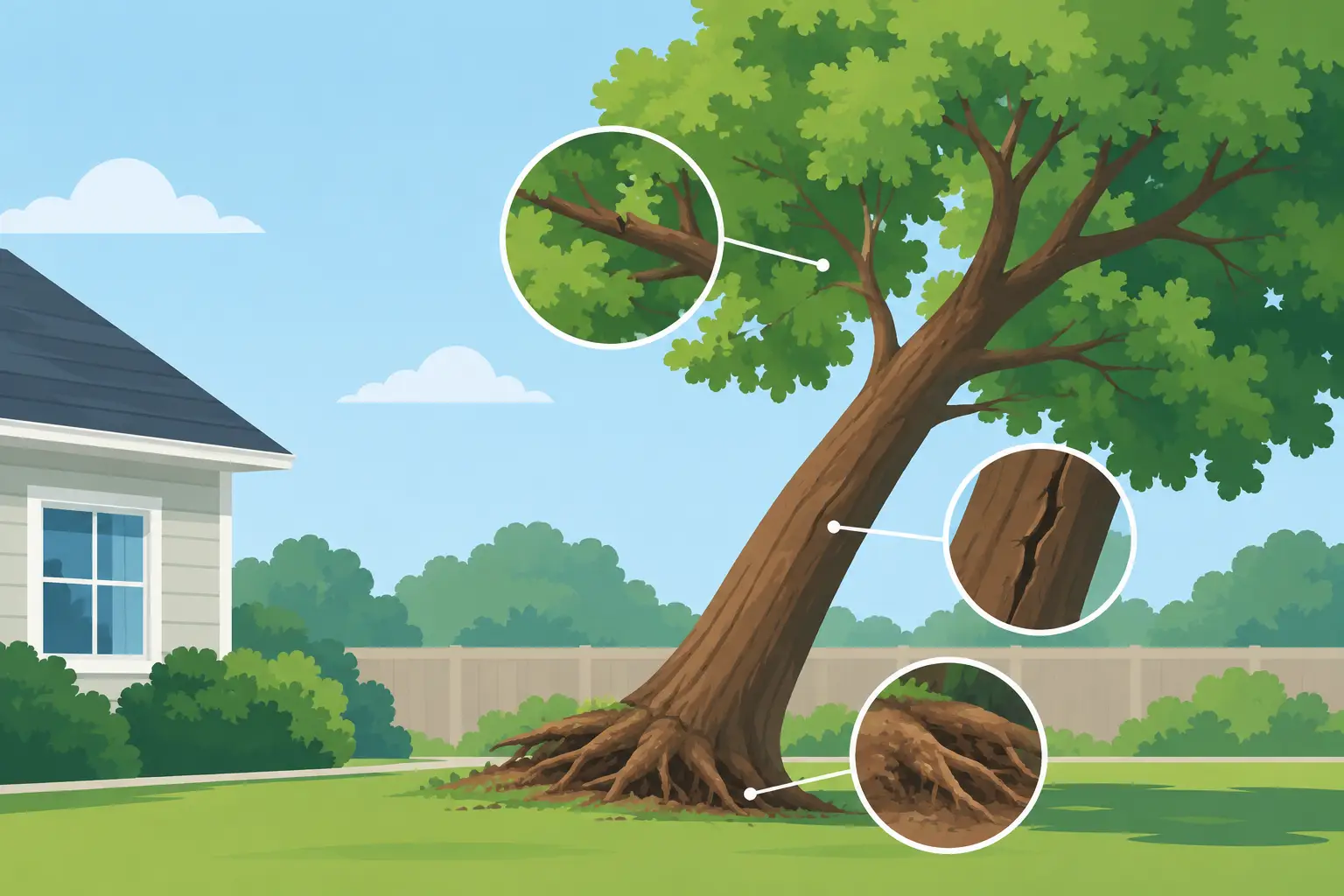
A tree that has stood straight for years and suddenly begins to lean deserves attention. If you are asking, why is my tree leaning, the answer may be as simple as uneven light or wind exposure. It can also point to root failure, soil movement, decay, or storm damage that puts your home, vehicles, utility lines, or people at risk.
A leaning tree is not automatically a tree that needs to be removed. Many trees develop a gradual, stable lean and remain healthy for decades. The concern is whether the lean is new, worsening, or accompanied by visible warning signs at the trunk, roots, or canopy. Knowing the difference can help New Haven County property owners make a sound decision before a small problem turns into an emergency.
Why Is My Tree Leaning? Start With the Timeline
The first question is not how far the tree leans. It is whether it has always leaned that way.
A mature tree that has grown at an angle since it was young may have adapted by building what arborists call reaction wood. The trunk often curves upward as the tree corrects toward the light, and the root system has had time to support its position. That tree still needs periodic inspection, particularly if it is near a building or driveway, but its lean may not be an immediate hazard.
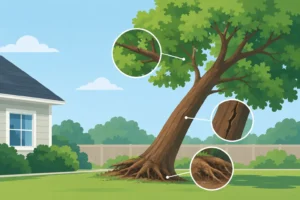
A newly leaning tree is different. If the trunk shifted after heavy rain, strong winds, construction, excavation, or a change in drainage, treat it as a possible structural issue. A tree can look healthy overhead while the support system below ground is failing.
Take a few photos from the same location and compare them over time. If the angle changes, the soil lifts around the base, or roots begin to show, do not wait for the next storm to have the tree evaluated.
Common Reasons Trees Begin to Lean
Saturated or Eroded Soil
Connecticut’s heavy spring rains, summer thunderstorms, and freeze-thaw cycles can loosen soil around a tree’s roots. When the ground stays saturated, it loses some of the strength needed to hold a large root plate in place. This is especially common in low spots, near poorly directed downspouts, or on properties with compacted clay soil.
Erosion can create the same problem. Water moving across a slope or along a drainage path may wash soil away from the base of a tree, exposing roots and weakening their anchor. The tree may lean gradually at first, then move much more after a wind event.
Root Damage or Root Loss
Roots do far more than feed a tree. The larger structural roots hold it upright. Damage from trenching, utility work, driveway installation, grading, or repeated vehicle traffic can reduce that support without creating an obvious problem right away.
Root decay is another concern. Fungi and rot organisms can weaken roots below the soil line while the canopy still produces leaves. Mushrooms or fungal growth near the base do not always mean a tree will fail, but they are worth taking seriously when paired with a new lean, thinning foliage, or dead branches.
Construction changes can be particularly hard on mature trees. Even adding soil over roots, changing the grade, or redirecting water can stress a tree that appeared healthy before work began.
Storm and Wind Damage
Wind does not have to snap a trunk to create a dangerous situation. Repeated wind pressure can shift a tree in wet ground, split roots, or worsen an existing lean. After a major storm, inspect trees from a safe distance for lifted soil, cracked ground, hanging limbs, or a trunk that now sits at a different angle.
A tree that leans toward a house after a storm should not be pulled with a truck, rope, or equipment from the ground. Improvised attempts can bring the tree down unpredictably, damage the structure, or injure someone nearby.
Uneven Canopy Growth
Trees naturally grow toward available light. A tree along a woods edge, beside a taller tree, or next to a building may develop more weight on one side of its canopy. Snow and ice can add even more load to those extended limbs during winter.
Careful pruning may reduce the sail effect and rebalance some canopy weight, but pruning is not a cure for a failing root system. When a tree has both a one-sided canopy and root or trunk problems, removal may be the safer choice.
Trunk Defects and Decay
A leaning trunk with a crack, cavity, seam, or area of missing bark needs professional attention. Internal decay can leave a trunk hollow or structurally weak even if its outer bark looks fairly normal. Multiple trunks joined in a tight V-shape can also split under load, particularly when one side is leaning away from the other.
The risk depends on the species, size, condition, target below, and location of the defect. A small ornamental tree in an open section of yard is not evaluated the same way as a large oak over a roofline.
Warning Signs That Call for a Prompt Inspection
One symptom alone does not always mean imminent failure. Several signs together should move the issue higher on your priority list. Watch for these conditions:
- Fresh cracks or heaving soil on the side opposite the lean
- Exposed, broken, or lifting roots around the base
- A new lean following rain, wind, excavation, or construction
- Deep trunk cracks, cavities, loose bark, or visible decay
- Large dead limbs, a sparse canopy, or branches falling without a storm
- Mushrooms or conks growing near the trunk base
- A tree leaning toward a home, garage, driveway, sidewalk, fence, or power line
If the ground around the tree is rising on one side, keep people and vehicles away from the area. That can mean the root plate is beginning to pull out of the soil. Contact a qualified, insured tree professional rather than trying to inspect underneath the lean yourself.
When a Leaning Tree Can Be Monitored
A gradual lean is often manageable when the tree has clearly grown that way over many years, shows no signs of root movement or decay, and is not close to a high-value target. A healthy young tree may sometimes be staked and corrected, but staking is generally not a solution for a mature tree. The stakes can create a false sense of security while the actual root problem continues underground.
Monitoring should be active, not passive. Check the base after storms, watch for soil changes, and pay attention to the canopy. If the lean increases or new defects appear, schedule an assessment.
Regular tree trimming can also help when overextended limbs are adding unnecessary weight. The goal is selective, proper pruning that maintains tree health and structure, not topping or cutting large sections off at random. Over-pruning can create weak regrowth and additional stress.
What Not to Do With a Leaning Tree
Do not climb a leaning tree, cut roots, or remove large branches without the proper equipment and training. A tree under tension can react in ways that are difficult to predict. It is also wise to avoid parking beneath it or letting children play around the root zone until its condition is known.
Be cautious about advice to simply pull the tree upright. Straightening a mature tree can tear remaining roots and accelerate failure. Likewise, filling cracks with material or piling mulch against the trunk will not correct a structural defect.
If utility lines are involved, stay well clear and contact the utility provider for electrical hazards. Tree crews working near energized lines require specialized training and procedures.
Choosing the Right Next Step
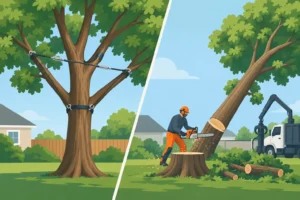
The right response depends on what is causing the lean and what could be damaged if the tree fails. A licensed arborist can evaluate the trunk, canopy, root zone, soil conditions, and the tree’s targets before recommending pruning, monitoring, cabling in limited situations, or removal.
When removal is necessary, the job should be planned around the property, not rushed with a one-size-fits-all approach. Large trees near homes, garages, fences, and landscaped areas often need to be dismantled in controlled sections. After removal, stump grinding and deeper root removal can help restore usable lawn or prepare the area for a new landscape plan.
Stumpbuster LLC has served New Haven County properties since 1985, providing arborist-led tree removal, trimming, stump grinding, and root removal with careful cleanup. If a tree has shifted, shows root movement, or hangs over an area people use every day, a timely professional evaluation is the safest way to protect both the tree, when possible, and the property around it.
A leaning tree rarely becomes safer by being ignored. Give it space, watch for changes after weather events, and get experienced eyes on it before the next strong wind makes the decision for you.