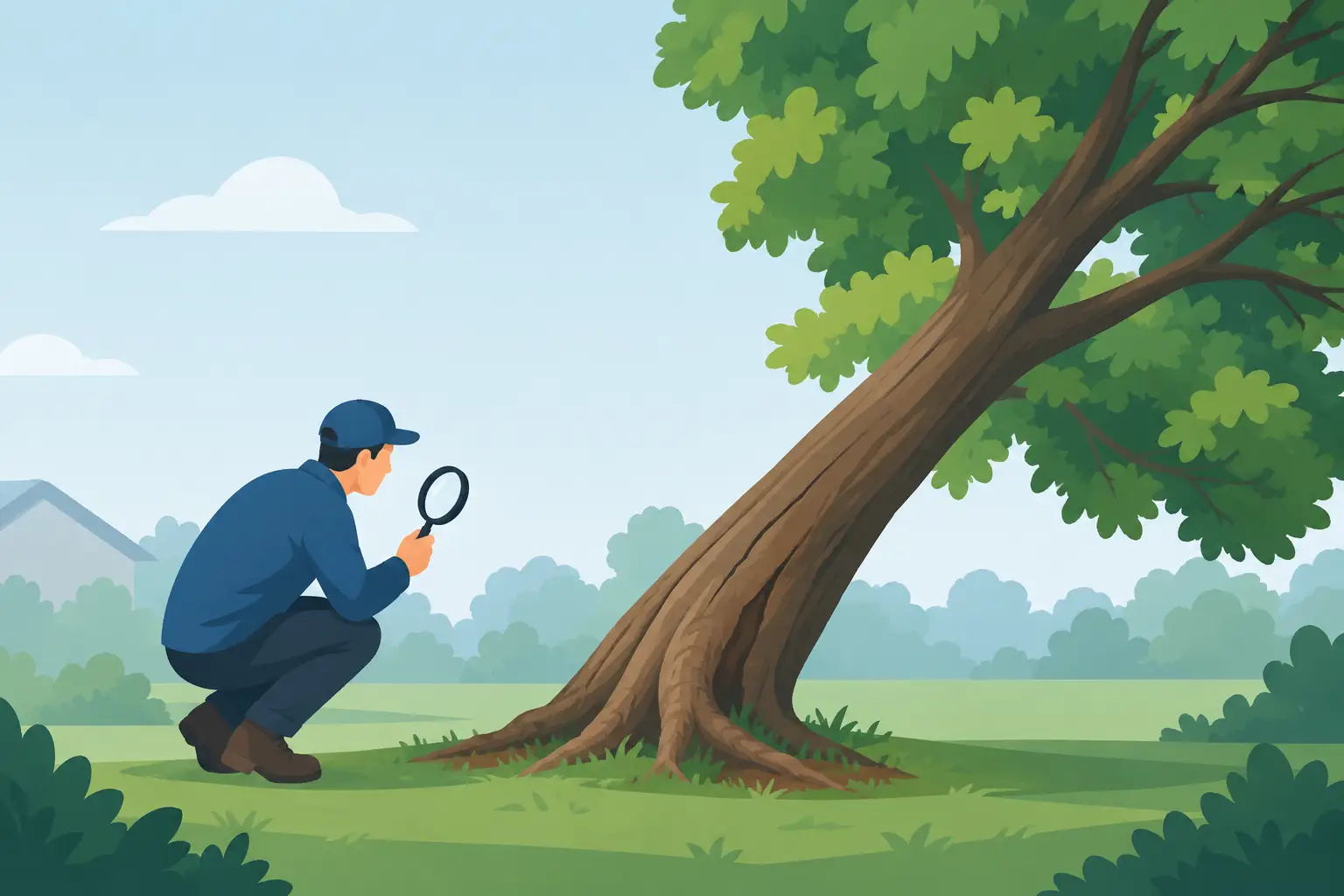
A tree that has stood straight for decades can become a serious property hazard after one wet season, a hard windstorm, or construction work near its roots. Knowing how to identify leaning trees helps you act before a falling trunk damages a roof, blocks a driveway, or puts people at risk. The key is not simply noticing that a tree leans. It is determining whether the lean is long-standing and stable or recent, active, and dangerous.
In New Haven County, mature trees face heavy snow, saturated spring soil, coastal storms, and the occasional high-wind event. Those conditions can expose root problems that were not obvious from the ground. A quick look from the yard can reveal a lot, but a close inspection by a licensed arborist is the right next step when a tree is near a house, utility line, sidewalk, parking area, or neighboring property.
How to Identify Leaning Trees That Need Attention
Start by looking at the tree from a distance. Stand far enough away to see the entire trunk from ground level to the crown. Compare it with nearby trees, fence lines, utility poles, or the edge of your home. A lean that has always been present is not automatically unsafe, particularly in a wooded area where trees compete for sunlight. A new lean, however, deserves prompt attention.
A practical rule is to pay attention to direction and change. If the tree is leaning toward a target such as a home, garage, driveway, play area, road, or power line, the consequences of failure are higher. If the lean seems more pronounced than it was last season, treat that as a warning sign even when the tree still has a full canopy.
Take dated photos from the same location if you are unsure. Comparing photos after storms or over several months can show whether the tree is moving. Do not rely on a single visual clue. The most concerning trees usually show a combination of root, trunk, and canopy symptoms.
Check the soil and root area first
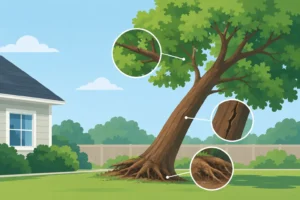
The roots are the tree’s foundation. When a tree begins to tip because its root system is failing, the ground often tells the story before the trunk does. Look around the base for lifted soil or a mound forming on the side opposite the lean. This can indicate that roots are pulling upward as the tree rotates.
Cracks or splits in the soil near the trunk also deserve attention, especially after heavy rain or wind. Freshly exposed roots, roots that have snapped near the surface, and a gap opening between the root flare and surrounding soil are other signs that the tree may be unstable.
Be especially cautious with trees growing in wet ground, on a slope, or in compacted soil. Waterlogged soil loses some of its ability to hold roots firmly in place. Excavation, driveway installation, patio work, and trenching for utilities can also cut critical roots well beyond the visible trunk. The effects may not show up immediately. A tree can decline or become unstable months or even years after root damage.
Look closely at the trunk
A leaning trunk with no visible damage may still be structurally sound, but cracks, cavities, and decay change the picture quickly. Check for vertical splits, peeling bark, large dead areas, mushrooms growing at the base, or soft, crumbling wood. These signs can point to internal decay that weakens the tree’s ability to withstand wind loads.
Also look for a bend or curve in the lower trunk. Trees that have slowly adapted to a lean often develop a curve as they grow upward toward the light. That shape may indicate a long-term condition rather than sudden movement. In contrast, a trunk that appears straight but abruptly tilted at the base can signal recent root failure.
Multiple trunks deserve extra attention. A tree with two or more large stems joined in a narrow V-shaped crotch may have included bark between them. Included bark prevents a strong connection and can create a weak point, particularly when one stem is carrying the weight of a pronounced lean.
Signs the Lean May Be Recent and Dangerous
A recent lean is more urgent than a tree that has grown at an angle for years. After a storm, walk the property only when it is safe to do so and look for changes around mature trees. Never stand beneath hanging limbs or under a tree that appears to be shifting.
The following signs call for a professional evaluation as soon as possible:
- Fresh cracks in soil, raised ground, or exposed roots around the base
- A noticeable change in the tree’s angle after wind, rain, or snow
- Splits in the trunk, loose bark, or new cavities near the lower trunk
- Large dead limbs, a broken top, or a lopsided canopy pulling heavily to one side
- Mushrooms or fungal growth at the base combined with a lean
- A tree leaning toward a house, occupied area, road, or utility line
One sign does not always mean a tree will fail. For example, mushrooms can grow on decaying material without proving that the entire root system is compromised. But when decay, root movement, and a new lean appear together, the risk increases substantially.
Do Not Judge Risk by the Tree’s Size Alone
Small leaning trees can be easier to remove, but they can still damage vehicles, fences, sheds, and young landscaping. Large trees deserve more caution because of their weight and reach, yet a healthy mature tree with a stable, long-term lean may be less concerning than a smaller tree with failing roots.
Species, soil, location, and condition all matter. Some trees naturally grow with a slight lean as they reach for light. Others have shallow root systems that are more vulnerable in saturated soil. A tree at the edge of a wooded lot may have developed differently after neighboring trees were removed, leaving it newly exposed to wind.
The target zone matters just as much as the tree itself. Think about where the tree could land if it failed. Its height is only part of the equation. Branches can extend well beyond the trunk, and a tree may break in sections rather than falling as one piece. If the possible fall zone includes people, buildings, power lines, or a frequently used drive, do not wait for visible collapse.
What Homeowners Should Not Do
Do not try to pull a leaning tree upright with a truck, winch, rope, or chain. A compromised tree can split, uproot suddenly, or shift in an unexpected direction. Cutting roots to make mowing easier, removing soil from around the base, or cutting heavy limbs without a plan can make an unstable tree more dangerous.
Avoid climbing a leaning tree or using a ladder against it. Even routine pruning can change the tree’s balance and place you directly in the strike zone. If a tree is tangled in a utility line or leaning close to one, stay clear and contact the utility provider or emergency services as appropriate. Tree companies should not work on energized lines unless they are qualified and equipped for that specific work.
For a tree that appears to be an immediate threat, keep people and pets out of the area. Move vehicles if you can do so without entering the hazard zone. Then arrange for an experienced, insured tree professional to assess the situation.
When Pruning Can Help and When Removal Is Safer
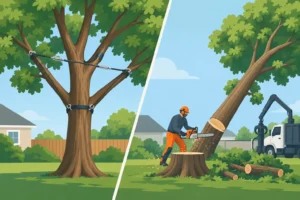
Not every leaning tree needs removal. Selective pruning can sometimes reduce wind resistance or remove overloaded limbs from a tree with a stable root system. Cabling or bracing may be considered for certain trees with structural weaknesses, depending on the species, size, condition, and location.
Those measures are not a cure for failing roots or advanced trunk decay. If the root plate is lifting, major decay is present at the base, or the tree has shifted suddenly toward a structure, removal is often the safer option. The right decision depends on the tree’s condition and the consequences if it fails, not on whether removal is the least expensive choice today.
A licensed arborist can assess the full picture: root condition, trunk defects, canopy weight, species characteristics, site drainage, and nearby targets. That is particularly valuable for older trees around homes in North Haven, Hamden, West Haven, Branford, Guilford, Wallingford, and surrounding communities, where mature landscapes often place large trees close to buildings and property lines.
Stumpbuster LLC has worked with local property owners since 1985 and understands the difference between a tree that simply grows at an angle and one that needs timely action. If a leaning tree is raising questions, a professional assessment can provide a clear recommendation and a safe plan for pruning or removal. It is better to make that call while the tree is still standing where it belongs.