That large oak or maple in the yard can look fine from the driveway and still be one storm away from dropping a major limb. One of the biggest problems with the signs of a dangerous tree is that many of them show up gradually, and property owners get used to seeing them. By the time the risk feels obvious, the tree may already be unstable.
In Connecticut, mature trees add shade, privacy, and value to a property. They can also become a serious hazard when age, storm damage, decay, poor structure, or root problems start to take hold. If a tree is close to your house, driveway, power lines, sidewalk, fence, or business entrance, waiting too long is where expensive damage usually starts.
Common signs of a dangerous tree
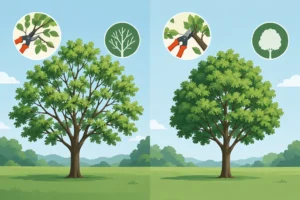
Not every flawed tree needs to come down. Some can be pruned, cabled, or monitored. But there are warning signs that should never be brushed off, especially when more than one appears at the same time.
1. The tree is leaning more than it used to
A tree that has naturally grown at a slight angle for years is different from a tree that recently started leaning. Sudden movement matters. If the soil around the base looks lifted, cracked, or heaved on one side, that can mean the root plate is shifting.
This is one of the clearest signs that the tree may no longer be anchored the way it should be. After heavy rain or wind, a newly leaning tree deserves fast attention.
2. Large dead branches are hanging in the canopy
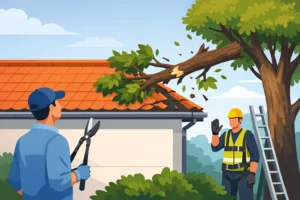
Dead limbs are not just an appearance issue. They get brittle, they fail without much warning, and they often come down during wind, snow, or even a hot dry stretch. The larger the limb and the closer it is to a house, parked car, or walkway, the greater the risk.
A few small dead twigs in the upper canopy may not mean the entire tree is failing. Large dead scaffold branches are a different story, especially if several are concentrated on one side.
3. You see cracks in the trunk or major limbs
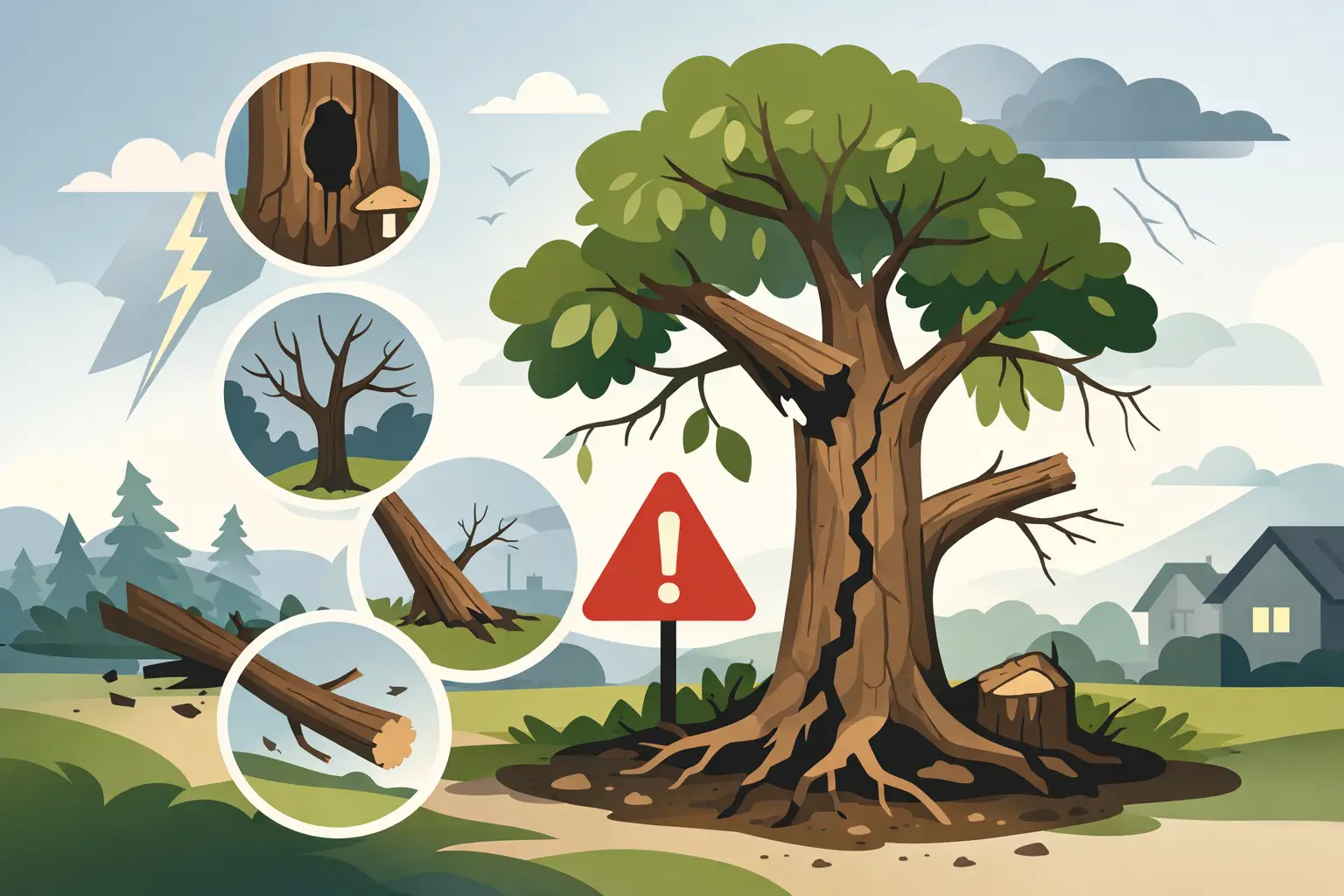
Deep vertical cracks, splits where major limbs join the trunk, and openings in the wood can all point to structural weakness. Trees do not fail just because bark is rough or ridged. The concern is when the crack goes beyond surface bark and into the wood underneath.
If a limb has a split attachment or the trunk shows a deep seam, that area may be under stress now, not later. In a storm, weak unions often separate fast.
4. The tree has hollow areas or visible decay
Decay is one of the most misunderstood tree hazards. A tree can live with some internal decay for years, but it depends on where the decay is, how extensive it is, and whether enough sound wood remains to support the tree.
Soft spots, cavities, crumbling wood, mushrooms near the base, and missing bark with dead tissue underneath can all indicate rot. Decay near the base or at a major branch union is more concerning than a small cavity in a less critical area.
5. Bark is falling off in large sections
Trees naturally shed some bark, depending on species. What you do not want to see is bark sloughing off in large dead patches, exposing dry wood beneath. When bark is missing and no new tissue is forming around the edges, the tree may have lost that section of living cambium.
That does not always mean immediate failure, but it is often a sign the tree is in decline. If canopy dieback is happening at the same time, the problem is more serious.
6. Roots are damaged, cut, or lifting out of the ground
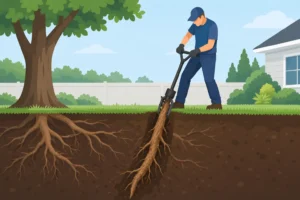
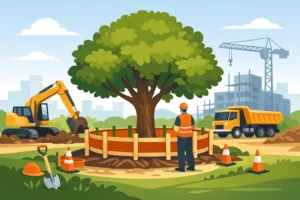
Roots matter more than most people realize. A tree can look full and green overhead while the real problem is below grade. Construction, trenching, repeated soil compaction, excavation, and grade changes can all weaken the root system.
If you notice exposed roots torn up by equipment, fungus at the base, or soil lifting around the trunk, do not ignore it. Root failure is one of the main reasons whole trees topple.
7. The canopy is thinning or dying back
A thin canopy in the wrong season may just be normal timing. A canopy that stays sparse during peak growing season is another matter. Dead branch tips, leaves that are much smaller than usual, and sections that never leaf out can all point to stress.
This sign on its own does not always mean the tree is dangerous. It may indicate disease, root injury, insect damage, or age-related decline. But when canopy dieback is paired with decay, cracks, or heavy deadwood, the risk level rises quickly.
8. Major limbs are growing with weak attachments
Some trees have multiple stems or large codominant trunks growing from the same point. When bark gets trapped between those stems, the connection is weaker than it looks. From the ground, the tree may seem solid. Internally, that union may be pushing itself apart year after year.
These failures are common in mature shade trees, especially after snow or high wind. If you can see a narrow V-shaped union with included bark and a noticeable crack, it should be evaluated.
9. Fungal growth is appearing on the trunk or near the base
Not every mushroom means a tree is unsafe. But fungal conks, shelf mushrooms, or repeated fruiting bodies near the trunk flare often suggest internal decay in the roots or lower trunk. That is an area where strength matters most.
The important question is not just whether fungus is present. It is what kind, where it is located, and whether the tree is also showing instability, dieback, or deadwood.
10. The tree has been hit before
Storm damage, lightning strikes, vehicle impact, and old topping cuts can leave behind hidden structural problems. A tree may survive the original event and still become hazardous later. Internal decay often starts in those damaged areas, and poorly attached regrowth from old topping cuts is especially prone to failure.
If a tree was badly damaged years ago, that history still matters. Trees do not always fail right after the injury.
When the signs of a dangerous tree mean immediate action
Some situations should not wait for a routine yard project. If the tree is leaning toward a structure, dropping large limbs, touching utility lines, or showing fresh cracks after a storm, treat it as urgent. The same goes for a tree with visible root movement or a hanging limb over an entry, driveway, or public area.
This is where experience matters. Tree risk is not just about whether a tree is alive or dead. It is about the chance of failure and what that failure can hit. A tree in the back corner of a large lot may allow more time for planning. A compromised tree next to a home or parking area does not.
What homeowners should do next
Start with a ground-level visual check. Look at the base, the trunk, the major limb unions, and the canopy. Take note of anything that changed recently. Leaning, soil movement, fresh cracks, and sudden dieback are worth paying attention to.
Then stop short of guessing. Tree hazards are one of those areas where do-it-yourself judgment can go wrong fast. A tree may look solid and be hollow. Another may look rough but still be manageable with proper pruning. It depends on species, age, defect location, and targets nearby.
If you suspect a problem, have the tree evaluated by a qualified professional with real field experience. In New Haven County, that often means dealing with mature trees in tight residential spaces, near homes, garages, fences, sidewalks, and service lines. An arborist-led company can help determine whether pruning will reduce the risk, whether support systems make sense, or whether removal is the safer option.
At Stumpbuster LLC, that practical approach has mattered to local property owners since 1985. The goal is not to remove every tree with a flaw. The goal is to identify real hazards, protect the property, and handle the work safely and cleanly.
A dangerous tree rarely improves by being ignored. If something about a tree on your property looks off, trust that instinct and get it checked before the next storm tests it for you.